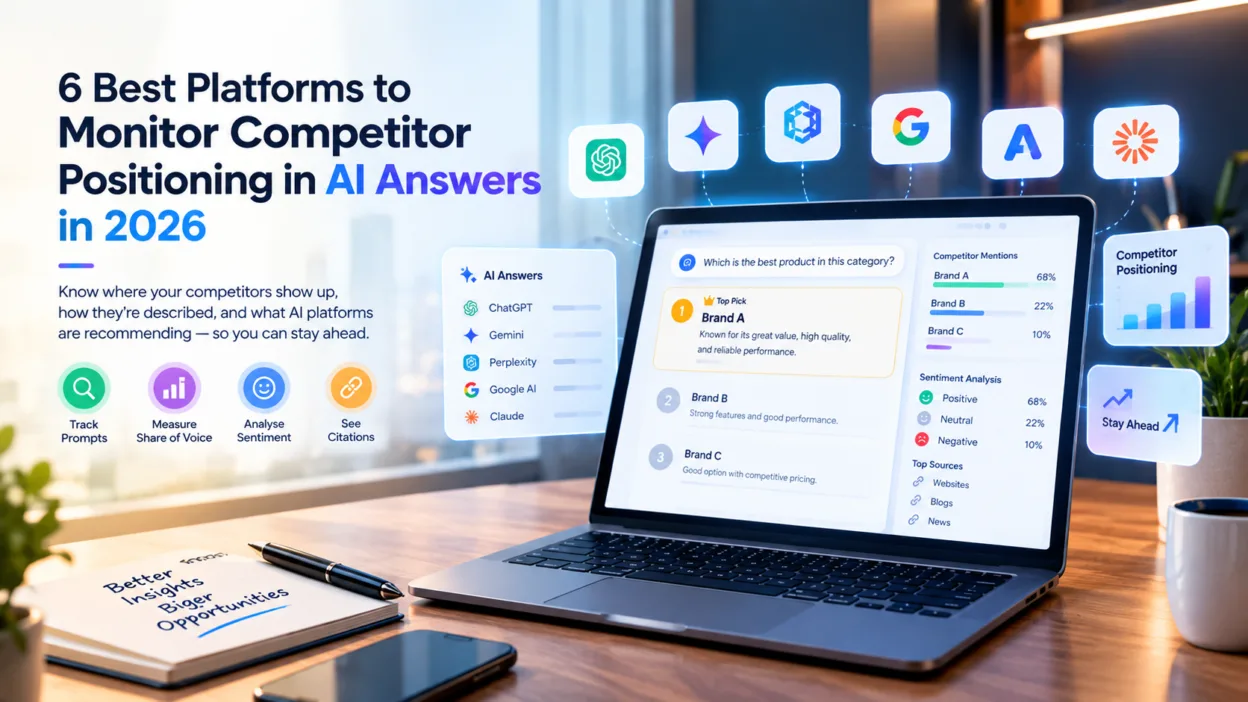
Ask ChatGPT for the best product in your category and read the answer closely. A handful of brands get named, one gets framed as the top pick and everyone else is invisible.
That short list has become a new kind of shelf space. If a rival keeps showing up in it and you don’t, you are losing buyers before they ever reach a search results page or a product listing.
The good news is that you no longer have to test prompts by hand and screenshot the results. A growing group of platforms now tracks which brands AI assistants recommend, how they describe them and where you stand in the lineup.
Key Takeaways
- AI assistants now shape shortlists before shoppers search, so competitor positioning in AI answers deserves the same attention as rankings.
- The strongest platforms combine prompt tracking, share of voice, sentiment and citation data in one place.
- Engine coverage varies widely by plan, so check which AI platforms your budget actually unlocks.
- Published entry prices range from under $30 to several hundred dollars a month, and one platform now sells brand plans only as custom contracts.
- Monitoring only pays off when you act on the gaps it reveals.
Why Does Competitor Positioning in AI Answers Matter Now?
Search behavior has been shifting for a while. Back in 2024, Gartner predicted that traditional search engine volume would drop 25% by 2026 as people turned to AI chatbots and virtual agents.
Whether or not that exact figure lands, the direction is clear. Buyers now ask assistants for recommendations and comparisons, and Semrush research found the average AI search visitor is worth 4.4 times the average traditional organic visitor, based on conversion rate.
Here’s the catch. Your traditional rankings can hold steady while a competitor quietly becomes the brand AI recommends first, and you won’t notice until sales start to slip.
Tracking competitor positioning answers three practical questions. Which prompts mention your rivals but not you? How is each brand described? And which sources do AI platforms cite when they make those recommendations?
How We Chose These Platforms
We focused on tools that go beyond a basic “is my brand mentioned” check. Every platform here lets you compare your visibility against named competitors across more than one AI engine, helping SEO experts evaluate competitor performance across traditional search and AI-generated answers.
We checked features and entry pricing against vendor documentation, public pricing pages and current independent reviews. We also weighed engine coverage, prompt limits, sentiment and citation analysis and how well the data fits into a wider marketing workflow.
Prices move quickly in this category. Treat the figures below as starting points and confirm them before you buy.
Quick Comparison
| Platform | Best for | AI visibility (entry plan) | Full SEO toolkit | Entry price |
| Semrush | Teams that want AI visibility and SEO in one platform | ChatGPT, Gemini, Perplexity, Google AI Mode, AI Overviews | Included in SEO + AI Search plans | $99/month (AI Visibility Toolkit) |
| Ahrefs | Existing Ahrefs subscribers | Selected platforms (standalone plan) | With a paid Ahrefs plan | $199/month (standalone) |
| Profound | Larger brands with enterprise budgets | ChatGPT, Gemini, AI Overviews on trial; up to 9 engines on Enterprise | No | Custom |
| Peec AI | In-house teams that want a clean dashboard | Three models of your choice | No | About $95/month |
| Otterly.AI | Small teams testing AI monitoring | ChatGPT, AI Overviews, Perplexity, Copilot | No | $29/month |
| Scrunch | Mid-market brands and agencies | ChatGPT, Perplexity, AI Overviews, Copilot | No | $250/month |
1. Semrush
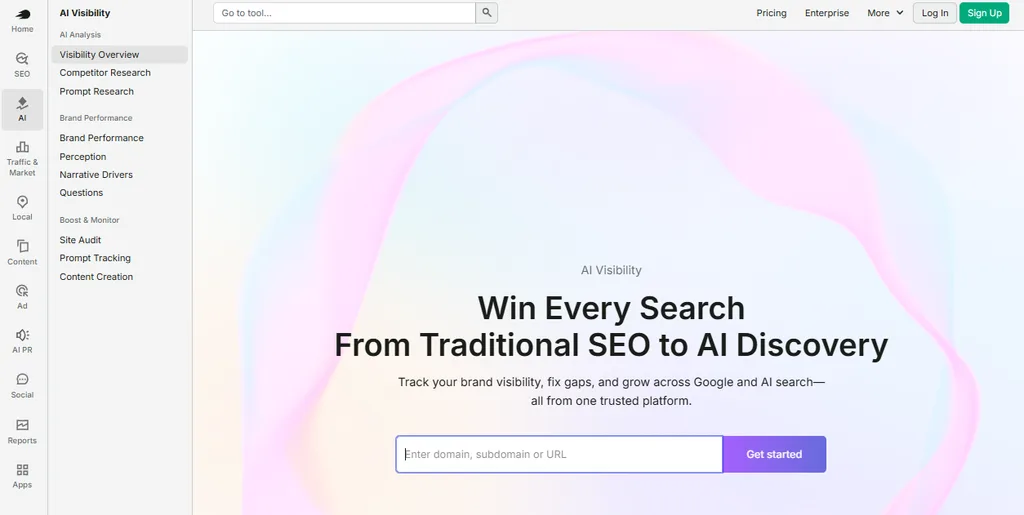
Semrush is a search visibility platform that covers SEO, content, competitive intelligence, PPC and AI visibility in one place. Its AI Visibility Toolkit shows how AI platforms present rival brands next to yours and flags the prompts where competitors get cited instead of you.
Best for
Marketing teams, agencies and ecommerce brands that want AI answer tracking alongside keyword, backlink and site audit data.
Key strengths
Inside the AI Visibility Toolkit, Competitor Research surfaces topic and prompt gaps, while Brand Performance breaks down share of voice, sentiment (positive, neutral or negative) and the narratives AI platforms attach to each brand.
Coverage spans ChatGPT, Gemini, Perplexity, Google AI Mode and AI Overviews.Prompt Tracking works like keyword tracking for AI search with daily updates, and citation data shows which sources AI platforms credit, which is useful for outreach. Semrush says acting on its own AI visibility data grew its AI share of voice from 13% to 32% in one month.
The AI Visibility Score, on a 0 to 100 scale, shows where your brand appears in AI answers and where it’s missing, and share of voice benchmarking compares you against up to nine competitors. It gives you a fast read on whether a rival is pulling ahead.
All of this sits next to core SEO tools like Keyword Magic Tool, Site Audit and Position Tracking. The data behind them is large, with over 43 trillion backlinks, 808 million domains, 317 million+ AI prompts and 142 geographic databases.
An AI Search Site Audit also flags technical issues that stop AI crawlers from reading your pages, including llms.txt and accessibility checks.
Larger organizations managing several brands or markets can step up to Enterprise AIO, the enterprise tier for AI optimization at scale.
Limitations
The standalone AI Visibility Toolkit includes 25 tracked prompts, and each extra Brand Performance domain adds to the cost.
Pricing
SEO plans start at $139 per month when billed monthly, and the AI Visibility Toolkit costs $99 per month on its own. Teams tracking more prompts typically move to combined SEO and AI Search plans, which cover 50 to 200 prompts daily, with current options on the pricing page.
2. Ahrefs
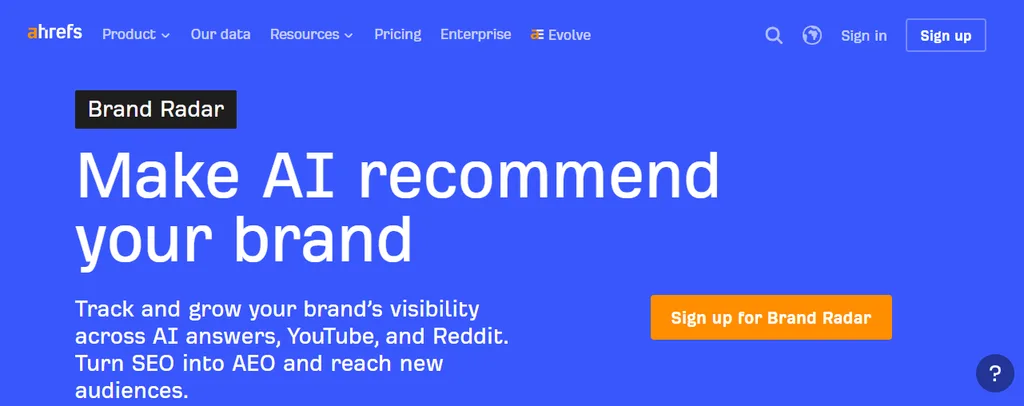
Ahrefs offers AI visibility through Brand Radar, a standalone tool that shows how often AI platforms mention and cite your brand compared with competitors. It sits alongside one of the most established backlink and keyword datasets in SEO.
Best for
Teams already using Ahrefs who want AI data inside a familiar interface.
Key strengths
- Brand Radar covers six AI platforms: Google AI Overviews, AI Mode, ChatGPT, Perplexity, Gemini and Copilot. Its core view shows AI mentions, AI citations and AI share of voice, so you can see how far ahead or behind a rival you sit on each platform.
- The built-in index draws on prompts derived from real search behavior rather than synthetic queries. That gives you a wide view of how AI platforms talk about your category without building a prompt list first.
- The All platforms plan adds custom prompt tracking with 2,500 checks a month, so you can monitor your own buying questions daily, weekly or monthly alongside the built-in dataset.
- Brand Radar also tracks branded search volume, the domains citing your brand and mentions across YouTube, TikTok and Reddit. For ecommerce brands, that matters because product reviews, unboxing videos and community threads often shape which brands AI assistants recommend.
- A May 2026 update added bot visits and AI traffic data for cited pages, so you can see which of your pages AI systems actually use.
Limitations
Brand Radar doesn’t track Claude, and covering every AI platform means stepping up to the top plan. Ahrefs’ SEO tools require a separate paid plan, so full AI and SEO coverage means two subscriptions. Platforms that bundle both avoid that split.
Pricing
Standalone plans start at $199 per month for selected platforms. The All platforms plan is $699 per month and includes 2,500 custom prompt checks.
3. Profound
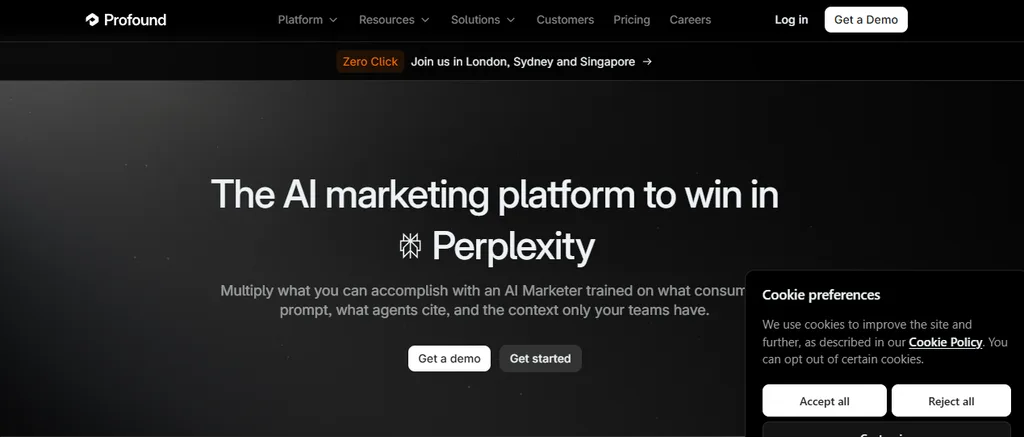
Profound is an AI marketing platform built specifically around answer engines. It tracks how brands appear in AI responses, benchmarks that visibility against competitors and uses AI agents to act on the gaps it finds.
Best for
Larger brands with enterprise budgets that want deep AI search data and help acting on it.
Key strengths
- Enterprise plans track up to nine answer engines, including ChatGPT, Perplexity, Gemini, Google AI Mode, Copilot, Claude and DeepSeek. That’s the broadest engine coverage in this list.
- For ecommerce brands, Enterprise adds ChatGPT Shopping visibility at SKU level, showing which products ChatGPT recommends and where yours sit against competitors.
- Answer Engine Insights tracks citations, sentiment, ranking and competitive presence, while Prompt Volumes estimates what people actually ask AI. Together they show which buyer questions matter most and who’s winning them.
- Profound’s AI Marketer identifies work worth doing, drafts it and asks for approval. FactCheck, launched in July 2026, compares the claims AI engines make about your brand against your own knowledge base and flags which cited pages drive inaccurate answers.
- Agent Analytics shows how AI bots view, cite and refer to your pages through CDN integrations such as Cloudflare, AWS and Vercel. Profound says a third of the Fortune 100 use the platform, and Plaid reports a 50% increase in its AI search visibility.
Limitations
Profound removed its self-serve Starter and Growth plans for brands in September 2026, so ongoing tracking requires a sales conversation. The free trial runs recommended prompts you can’t customize, with no history or exports.
Pricing
Brand pricing is a custom Enterprise quote. A free trial runs 50 prompts daily for 7 days across ChatGPT, Gemini and Google AI Overviews.
4. Peec AI
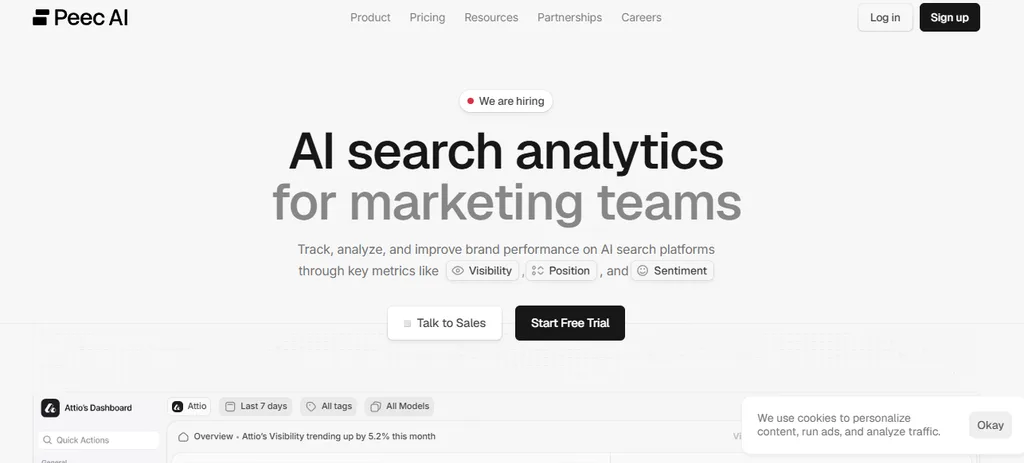
Peec AI is an AI search analytics tool known for a clean, easy-to-read dashboard. It tracks visibility, position and sentiment for your brand and competitors across the prompts you choose.
Best for
In-house marketing teams that want quick adoption across the whole department.
Key strengths
- Every plan includes unlimited seats and daily tracking, so content, PR and leadership can all work from the same competitor data without paying per user.
- You choose three AI models from a standard set that includes ChatGPT, Perplexity, Gemini, Copilot, Google AI Mode and AI Overviews. That lets you match coverage to the assistants your customers actually use.
- Visibility, position and sentiment sit side by side for you and each competitor. You can see whether a rival is winning more mentions or simply being described more favorably, which calls for a different response.
- Source and citation analysis shows which sites AI platforms rely on when answering your tracked prompts. That points directly to the review sites, publications and roundups worth targeting for coverage.
- Plans scale by projects as well as prompts: Starter covers one project, Pro covers two and Advanced covers five, with multi-country tracking and a Looker Studio connector on Advanced. That suits brands selling in several markets.
Limitations
Self-serve plans are capped at three AI models, and additional models are paid add-ons. Peec AI is built for AI search analytics, so keyword research and backlink analysis need a separate SEO platform.
Pricing
Plans start at $95 per month for 50 prompts. Pro offers 150 prompts for $245 per month, and Advanced offers 350 prompts for $495 per month. Prices are shown in euros for European visitors.
5. Otterly.AI
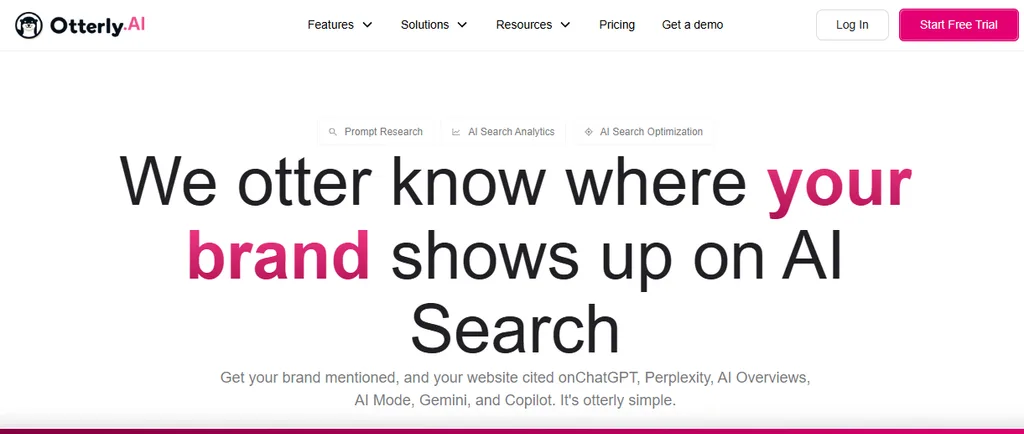
Otterly.AI is a low-cost way to monitor brand mentions and website citations in AI answers. It compares your coverage with competitors across the prompts you choose.
Best for
Small brands and solo marketers who want to test AI monitoring before committing a bigger budget.
Key strengths
- Every plan tracks ChatGPT, Google AI Overviews, Perplexity and Microsoft Copilot daily, with unlimited team members. Google AI Mode and Gemini are available as paid add-ons from $9 per month on the Lite plan.
- Brand mention and website citation reports sit side by side. You can spot answers that name a competitor and link to their site while yours goes unmentioned, which is the gap most worth closing.
- GEO URL audits check your own pages for AI crawlability and content issues, with 1,000 audits a month on Lite, 5,000 on Standard and 10,000 on Premium. That’s useful for checking product and category pages before you rework them.
- An AI prompt research tool helps you find the questions shoppers ask in your category, so your tracked prompts reflect real buying intent rather than guesses.
- Standard adds a Looker Studio connector and API access, and teams on Standard or Premium can add 100 extra prompts for $99 per month. Otterly.AI was also named a Cool Vendor in the 2025 Gartner Cool Vendors for AI in Marketing.
Limitations
The Lite plan covers only 15 prompts, which suits a pilot more than ongoing competitor tracking. It’s built for monitoring, so backlink analysis and classic rank tracking need a separate SEO platform.
Pricing
Plans start at $29 per month for 15 prompts. Standard offers 100 prompts for $189 per month, and Premium offers 400 prompts for $489 per month.
6. Scrunch
Scrunch is an AI search visibility and optimization platform aimed at mid-market brands and agencies. It pairs competitor monitoring with monthly site audits, so you can see where rivals win and check whether your own pages are ready for AI crawlers.
Best for
Growing brands and agencies that want a larger prompt allowance with room to scale into enterprise AI optimization.
Key strengths
- The Core plan covers ChatGPT, Perplexity, Google AI Overviews and Copilot with 125 unique prompts, the largest entry-level prompt allowance in this list. That’s enough to track a full set of category, comparison and product questions for one brand.
- Core includes competitor benchmarking, sentiment analysis and citation-level insights, so you can see which rivals AI platforms favor, how each brand is described and which sources drive those answers.
- Five site audits a month check your own pages for issues that limit AI visibility, which pairs well with the competitor data when you’re deciding what to fix first.
- Core includes one brand workspace and five user licenses, with three personas to model different buyer types. Agencies can choose Agency Core at $500 per month, which includes 250 prompts, unlimited users and three brand workspaces.
- Enterprise expands coverage to up to nine engines, including Claude, Gemini and Google AI Mode, and adds API access, Looker Studio and the Agent Experience Platform, which serves AI agents machine-readable versions of your pages.
Limitations
At $250 per month, it costs far more than the budget trackers on this list, and Core covers the same four engines some cheaper tools offer. Broader engine coverage requires Enterprise pricing.
Pricing
Core costs $250 per month with a seven-day free trial and no credit card required. Enterprise is custom priced for broader engine coverage and advanced features.
How Can Ecommerce Brands Act on Competitor AI Data?
Monitoring is only useful if it changes what you do next. Start with the prompts where competitors appear and you don’t, then look at the sources AI platforms cite in those answers.
Often the gap comes down to off-site presence. AI assistants lean on review sites, editorial roundups and community discussions, so a rival with steady third-party coverage can outrank a stronger product.
Shopify store owners face the same dynamic. Product listing clarity, detailed Q&A and review sentiment all shape AI search recommendations, and a competitor with richer product content may win recommendations that should be yours.
Re-check your tracked prompts after every major content or listing update. AI answers shift over time, and a steady review cadence shows which changes actually moved your position.
Final Thoughts
The brands AI assistants recommend are winning buyers before a search even starts. Tracking where competitors sit in those answers turns a blind spot into something you can measure and improve.
Pick a platform that covers the AI engines your customers actually use, start with a focused set of high-intent prompts and review the gaps regularly. Small, consistent adjustments tend to compound.
FAQs
1. What does it mean to monitor competitor positioning in AI answers?
It means tracking which brands assistants like ChatGPT, Gemini and Perplexity recommend for relevant prompts. You also see how each brand is described and where yours ranks in that lineup.
2. Which AI platforms should I track first?
Start with the assistants your customers use most. For many brands that means ChatGPT and Google AI Overviews, with Perplexity, Gemini and Copilot added as budget allows.
3. How many prompts do I need to track?
A focused set of high-intent prompts is enough to spot clear patterns. Expand once you know which topics drive recommendations in your category.
4. How often does AI visibility data update?
It depends on the tool and the report. Several platforms on this list refresh tracked prompts daily, while broader research reports may update on a different schedule.
5. Can I improve how AI assistants position my brand?
Yes, though it takes time. Stronger third-party coverage, clearer product content and fixing technical blocks for AI crawlers all improve your odds of being recommended.