
Procurement managers come to B2B platforms with a very specific list in hand. They know exactly what they need, down to the certification standard, the warehouse split, and the pricing tier their contract guarantees. There’s no browsing involved.
The problem is that the standard keyword search breaks down at this level of specificity. Off-the-shelf AI chatbots don’t fare much better. They can hallucinate specs, or quote list prices instead of negotiated tiers, and, in general, have no real visibility into your ERP or live inventory. A procurement manager who gets a confident wrong answer wastes more time than one who got no answer at all.
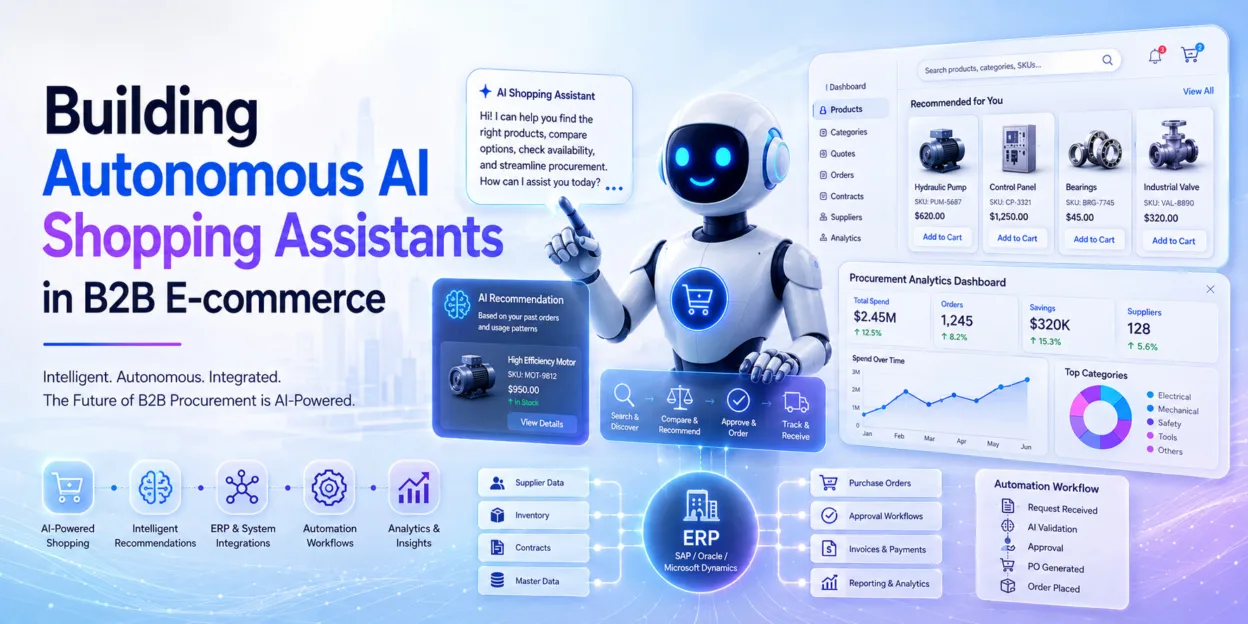
That’s why B2B platforms are moving toward autonomous AI shopping assistants built on Retrieval-Augmented Generation (RAG). This brief article explores opportunities of RAG systems for e-commerce. Read on to see how to build one and when to expect the measurable ROI.
Why Off-the-Shelf AI Fails in B2B E-commerce
Off-the-shelf AI models have no access to a company’s live inventory or pricing information. They work from static training data. That means they routinely produce inaccurate product specifications and pricing. Sometimes confidently so.
This is where things get costly. A B2B sales cycle involves long-term contracts and technical compliance requirements. And if an AI assistant tells a client that a specific component meets a certain industrial standard, and it doesn’t, the company can end up with failed audit or a breach of contract conversation. These can take months or even years to recover from.
The underlying issue is that general-purpose AI has no concept of your business. It doesn’t know your SKU catalog, customer tiers, stock levels, or supplier lead times. It was trained on public data, and it answers from that pool, filling gaps with plausible-sounding but fabricated details. In consumer e-commerce, that’s an inconvenience. But in B2B, it’s a liability.
Standard Chatbots vs. RAG-Powered Autonomous Assistants
A basic AI chatbot wrapped around a general-purpose language model and a true RAG architecture are solving fundamentally different problems. One is built for conversation, the other is built for procurement.
| Capability | Standard AI Chatbot | RAG-Powered Assistant |
| Data Source | Pre-trained model with a fixed knowledge cutoff | Live vector database synced with your PIM and ERP |
| Pricing Logic | Generic list pricing, no contract awareness | Tenant-specific contracted tiers pulled in real time |
| Inventory Awareness | None | Live stock levels, warehouse locations, lead times |
| Product Accuracy | Prone to hallucination on specs and certifications | Grounded in your actual datasheets and product records |
| Actionability | Can describe products, can’t act on them | Can generate purchase orders and add items to cart autonomously |
| Compliance | No awareness of regulatory or technical standards | Retrieves compliance data directly from indexed documentation |
The practical difference shows up fast. A standard chatbot might correctly identify that your catalog carries a particular industrial sensor, but quote the wrong voltage rating because it’s interpolating from training data rather than reading your actual product sheet. A RAG system pulls the indexed datasheet, reads the spec, and cites the source.
The Architecture of a B2B RAG Shopping Assistant
At its core, a RAG pipeline does three things: it ingests your data, retrieves the right pieces when a query comes in, and uses that retrieved context to generate a grounded, accurate response. Let’s explore each stage.
Data Ingestion & Chunking
B2B product catalogs are a mix of structured data from your PIM system, unstructured technical PDFs, supplier spec sheets, compliance certificates, and pricing tables that vary by customer segment.
Getting this into a vector database requires more than a bulk export. Each document needs to be broken into meaningful chunks, small enough for precise retrieval and large enough to preserve context. A chunk that cuts a technical specification in half is worse than useless. It will produce a confident, incomplete answer.
A few principles that matter at this stage for enterprise AI e-commerce:
- Chunk by semantic unit. A product spec should stay together.
- Preserve metadata – SKU, supplier ID, pricing tier, last-updated timestamp, so the retrieval layer can filter by more than just semantic similarity.
- Version your embeddings. When a product spec changes, the old vector needs to be replaced.
Semantic Retrieval
When a user submits a query, say, “find me a sealed relay rated for 24V DC that meets EN 61810”, the system converts that natural language input into a vector embedding and searches for the closest matches in the database.
This is where semantic search outperforms keyword search. The embedding model understands that “sealed relay” and “hermetically sealed electromagnetic switch” are describing the same thing.
What makes retrieval work well in B2B specifically:
- Hybrid search combining vector similarity with structured filters (price range, stock status, certification type) gives far more precise results than either approach alone.
- Re-ranking the top retrieved results before passing them to the LLM improves answer quality significantly, especially for catalogs with overlapping SKUs.
- Customer context should be injected at the retrieval stage, so the system only surfaces products and pricing relevant to that specific account.
Prompt Grounding
Once the right documents are retrieved, they get injected into the LLM prompt as context. The model is explicitly instructed to answer only from what’s been provided, and to flag when the retrieved data doesn’t contain enough information to give a complete answer.
This is the mechanism that prevents hallucination. The LLM isn’t reaching into its training data for product details. It’s reading a document you handed it. If the document doesn’t mention a spec, the model says so rather than inventing one.
A well-structured grounding prompt will also tell the model how to handle conflicts. For example, if two retrieved chunks give different stock quantities for the same SKU, the system should surface that discrepancy rather than silently picking one.
Overcoming Integration Challenges: ERPs and Dynamic Pricing
The hardest part of building a B2B e-commerc RAG is the backend. Keeping a vector database in sync with an ERP system that was never designed to talk to one is where most implementations hit a wall.
Pricing alone is complex enough. A single SKU can carry different prices depending on the customer’s contract, their order volume, and active promotional agreements. Getting that logic to reflect accurately in real time requires more than a scheduled data pull.
Three integration problems that consistently slow teams down:
- Sync timing. Batch updates leave a window where the AI recommends products that are already out of stock.
- SKU mapping. ERP, PIM, and supplier systems rarely use the same product identifiers. Without a mapping layer, retrieval breaks on edge cases.
- Pricing isolation. Contract pricing must never surface to the wrong account. This needs to be enforced at the retrieval layer, not patched in the prompt.
Integrating a Retrieval-Augmented Generation (RAG) system into a B2B platform with hundreds of thousands of complex SKUs is not a plug-and-play task. Off-the-shelf AI chatbots often hallucinate product specifications or fail to apply customer-specific pricing tiers. To build an autonomous shopping assistant that securely connects to your proprietary ERP and product databases, enterprise brands typically partner with specialized engineering teams like SpdLoad. Their expertise in custom RAG development ensures that the AI delivers precise, context-aware product recommendations without compromising your platform’s backend architecture.
Designing the UX for Autonomous B2B Procurement
B2B procurement UX has some specific requirements that consumer-facing chat interfaces don’t account for:
- Inline comparison tables. When a buyer asks for options, the AI should generate a structured table on the spot (specs, pricing, lead times, stock levels, etc).
- One-click “Add to Quote.” The assistant should be able to act. A buyer who’s found the right product shouldn’t have to leave the chat to do anything with that information.
- Source citations. When the AI references a spec or certification, it should show exactly which datasheet it pulled that from.
- Transparent stock and pricing context. If a product is showing a contracted price or limited availability, the interface should make that visible.
The goal is an assistant that feels less like a chatbot and more like a knowledgeable colleague who happens to have your entire catalog memorized and knows your account history.
Measuring the ROI of a RAG Shopping Assistant
ROI on an AI investment is easy to overclaim. Here are the metrics worth tracking:
| Metric | What It Measures | Why It Matters |
| Time-to-Purchase | How long from first query to confirmed order | Shorter cycles mean faster revenue and less buyer drop-off |
| Support Ticket Volume | Inbound questions about stock, specs, and pricing | A direct measure of how much the AI is absorbing routine sales work |
| Average Order Value | Revenue per transaction | Context-aware cross-selling surfaces relevant additions the buyer may have missed |
| Quote Accuracy Rate | How often AI-generated quotes match final invoices | Tracks whether pricing and spec data is staying in sync |
| Self-Service Rate | Orders completed without sales team involvement | Shows how much the assistant is functioning as an autonomous channel |
Conclusion
A RAG shopping assistant is a backend project as much as an AI one. The language model matters, but what drives real results is clean data, reliable ERP sync, accurate pricing, and a UI buyers can actually use.
The ROI shows up in the metrics that matter to the business:
- Time-to-purchase.
- Support ticket volume.
- Average order value.
And the best thing is that it grows as the system handles more real queries from real accounts.
The architecture covered in this article, including data ingestion, semantic retrieval, prompt grounding, and ERP integration, reflects what a production-grade implementation requires.
Each layer depends on the one before it. A well-indexed catalog makes retrieval accurate. Accurate retrieval makes the AI’s answers trustworthy. Trustworthy answers make buyers confident enough to complete orders autonomously. That chain is what separates a useful procurement tool from one that gets abandoned after the first wrong quote.