

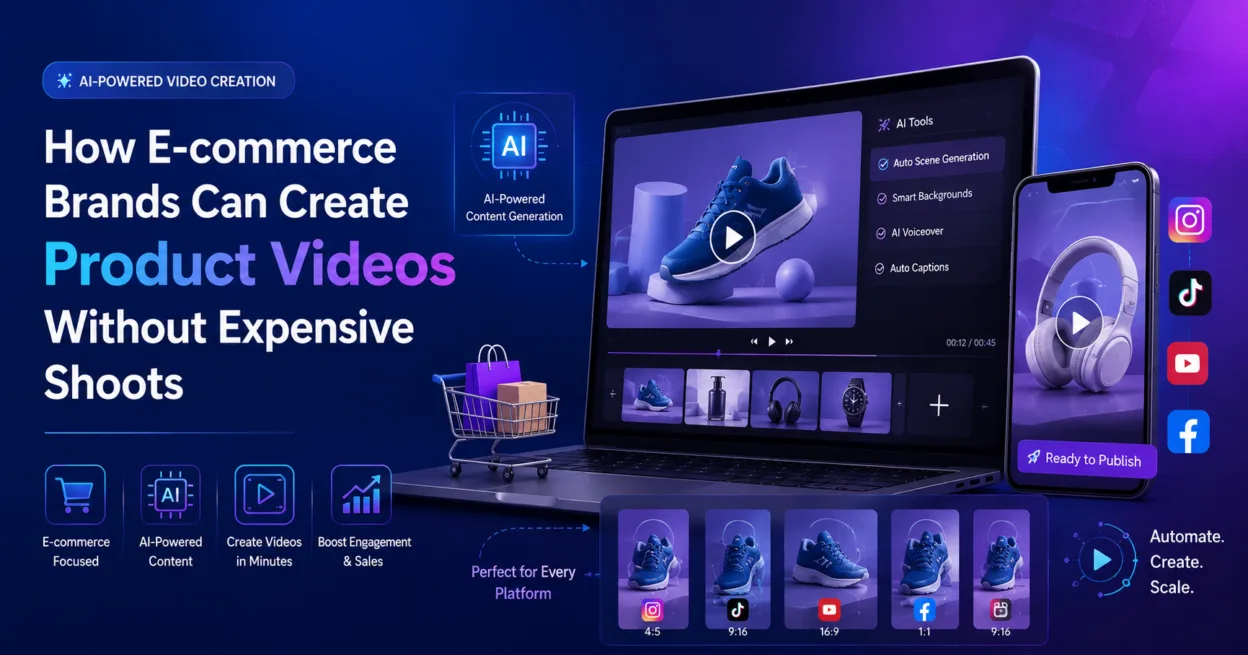
As an e-commerce business owner, you know that your product images are not working for you anymore. Before customers click “Buy,” they want to see the products moving in their context and in action. The problem is that making the traditional sort of video is costly, time-consuming, and messy to operate for most online brands.
Hiring a videographer, booking a studio, handling models, multiple rounds of editing, and paying the agency fees will take the price of one professional video a lot further than a few thousand dollars. When you have hundreds of SKUs and fresh content to get published every couple of weeks, that math just doesn’t add up for small and mid-sized e-commerce businesses.
However, the difference between brands’ requirements and their production is narrowing. A new way of creating video is coming into play, especially with the help of AI, that enables e-commerce teams to create product videos without having to assemble a team of professionals or drain their marketing budget.
Why Product Videos Actually Matter for Sales
It’s important to understand what product videos do for e-commerce conversions before diving into the how.
Data indicates that product pages that feature a good video with a demonstration get 84% more conversion than those that display only an image. The average conversion rate for websites with embedded video is 4.8% compared to 2.9% for sites without, a 65% increase due to video.
The numbers for add-to-cart are no less interesting. On product pages, Invesp data shows that the percentage of add-to-cart conversions is 37% higher with video than without video. And when it comes to consumer preferences, 78% of people would prefer to find out about a product by watching a short video, rather than reading a text-based article.
This is nothing particularly shocking. Consumers do not have the opportunity to view and experience the product virtually. A good video is able to fill in that void by demonstrating texture, size, motion, and context to a better degree than a wonderful photograph can.
The Real Problem With Traditional Product Video Production
It’s not the fact that brands don’t understand the value of video. Most do. The problem lies with the production pipeline.
Traditional video production costs usually run around $4,500 per minute, with all the costs involved, such as crew, location or studio hire, talent, lighting, sound, and post-production editing. This can be a significant bottleneck for a small e-commerce company that has to launch new products and follow seasonal marketing campaigns regularly.
The time limitation is there, too. The length of time for a professional 1-minute marketing video is typically about 13 days from start to finish. That’s a weekly video output that is hard to maintain without a big budget for a company that is required to release new content on a regular basis.
That’s why, even with the knowledge of the value of video, only roughly 40% of e-commerce stores today feature product videos. The main reason is the production barrier.
Practical Approaches to Creating Product Videos Without a Shoot
Fortunately, there are several legitimate approaches that don’t require booking a studio or hiring a production crew that you can use to create good product video content.
1. AI-Powered Video Generation
AI video tools are no longer just a novelty. By 2025, almost 79% of e-commerce brands are employing videos created by artificial intelligence to promote their products online. Tools like Higgsfield AI are helping push this technology further, making AI-generated video creation more accessible and versatile. The technology is now advanced enough that it can process entire videos, rather than isolated clips, and accommodate a multi-scene story, realistic-looking characters, accurate lip sync, and quality video.
These can be used to give a product description, choose a character or visual style, and be presented with the video in less time and at a fraction of the price of a conventional shoot. Zebracat data shows the production time for a one-minute AI-generated video has decreased from 13 days to approximately 27 minutes. Those companies that have adopted the change are claiming cost reductions of 70-90% from the conventional production processes. Brands that want to test this shift without committing budget upfront can start with a free ai video generator to prototype a first video and evaluate the output before scaling to a paid plan. Tools like the Higgsfield AI Video Generator make this process even more efficient by enabling marketers to create cinematic product videos with AI-powered camera movements, realistic visuals, and multi-scene storytelling from simple text or image prompts.
The reason that AI video generation is so useful for e-commerce is that it’s easy to create multiple versions of the same product videos, with different formats, different angles, and different lengths, depending on the platform, without the need for a separate shoot each time.
2. User-Generated Content (UGC) Style Videos
The UGC-appearing videos (those that are shot by a real customer and made with a phone) beat the standard studio video format when it comes to paid social results every single time. The authenticity it conveys, the slightly off-camera shots, the natural lighting, and the natural speech are the same things that make consumers trust it.
Brands can create UGC-style video with only micro-creators who charge much less than traditional production companies. Or, AI avatars that have been trained to create UGC-style delivery can deliver the same style and appearance without any external talent whatsoever.
It works particularly well for social ads, product announcement emails, and content like reviews, which doesn’t necessarily require a polished look.
3. Product-Only Videos Using Existing Assets
It’s not always necessary to have a human in a product video. A good motion video that uses existing product photos and focuses on the product has great potential for many categories, especially home goods and accessories, apparel, and tech products.
This means using photographs of your products as the starting point to turn images into videos with movement, zooms, transitions, and a background that depicts the context in which your product is used. The end product is a video that is lively without having to shoot a new video altogether. You’re basically bringing to life assets that you already have.
This is a great place to start for brands that have a lot of product photos to begin with but which never got to the stage of creating video.
4. Screen Recording and Demo Videos
If the function is more important than the form, whether it’s software, apps, digital products, or anything else, a simple screen recording or walkthrough may be one of the best types of video you can create. Users like to observe its functionality before buying it.
These videos are very inexpensive to make, outside of the time required to prepare a script for the video and record a clean walkthrough. There are a variety of tools out there for creating screen recordings, and simple editing can be performed without the expertise of a professional post-production team.
What to Keep in Mind When Choosing an Approach
Not every product category calls for the same video approach, and it is worth thinking through a few things before committing to a particular method.
- Volume requirements: If you are launching new SKUs frequently, you need a production approach that can scale with your catalog without creating a bottleneck every time.
- Platform formats: A video that works on your product page will likely need to be reformatted for Instagram Reels or TikTok. Choose a method that gives you flexibility on output dimensions and lengths.
- Brand consistency: Especially with AI-generated content, maintaining a consistent visual identity, the same character, the same tone, and the same style across all videos matters more than it might initially seem. This is particularly important as you build brand recognition.
- Final output quality: The quality bar has risen for consumers. AI tools have improved significantly, but it is still worth checking that the platform you choose can handle realistic movement, accurate lip sync if a character is speaking, and coherent scene construction from beginning to end.
Frequently Asked Questions
1. Can AI-generated product videos actually perform as well as traditionally produced ones?
Yes, and in some cases better. AI-generated demos are achieving conversion rates around 20% higher than static product images in early case studies. For paid social in particular, AI-generated UGC-style video often outperforms expensive studio content because it looks and feels more organic to the feed.
2. What kinds of products work best for AI video creation?
Most physical product categories translate well, including apparel, beauty, home goods, electronics, accessories, and food products. Categories where you need to demonstrate a tactile experience or show precise fit may require more thoughtful scripting to compensate for not having a live model, but the tools available today can handle most of these scenarios.
3. Do I need video editing skills to use AI video generation tools?
Most modern AI video platforms like Intellemo AI are built specifically so that you do not need editing experience. You provide inputs like product information, character preferences, and tone, and the platform handles scene construction, transitions, voiceover, and output formatting. The learning curve is generally short.
4. How do I make sure AI videos stay on-brand?
The most reliable way is to choose a platform that supports consistent character and voice settings across projects. Using the same visual style, the same tone in scripts, and maintaining your brand’s color references throughout will create consistency even when you are producing at scale. Treating video templates as you would any other brand asset, something to be defined and documented, will save a lot of inconsistency over time.
Conclusion
The barrier between e-commerce brands and consistent video output is no longer technical capability or content quality. The tools exist. The cost structure has shifted dramatically. The production timeline has compressed from days into minutes for brands using AI video generation.
What remains is the decision to move away from a shoot-first mindset and toward a workflow that fits the reality of modern e-commerce content demands. Whether that means working with AI generation platforms, adopting a UGC-style approach, or building video from existing product photography depends on your brand, your product category, and how fast you need to move.
What is clear is that waiting for the perfect studio-quality production moment is no longer a viable reason to skip video entirely. The brands pulling ahead on product page conversion and paid social performance are the ones who figured out how to produce video at the pace the platforms demand, without the overhead that used to make that impossible.