
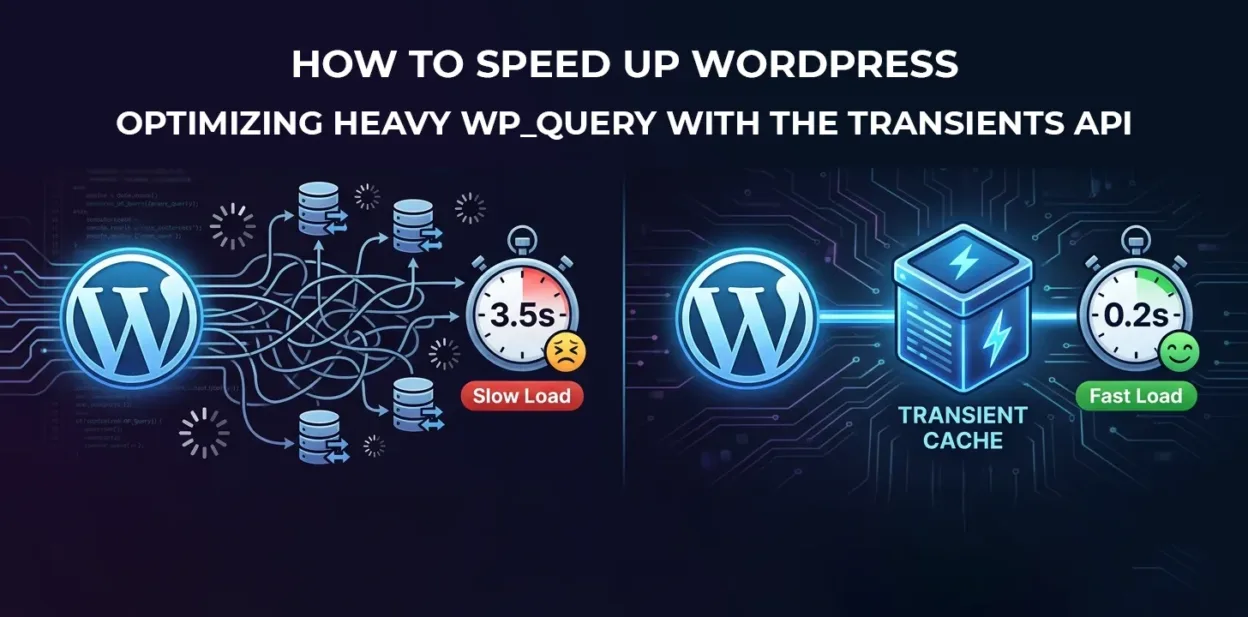
The flexibility and power of WordPress can present a challenge in terms of performance, especially as your site grows. Running a lot of WP_Query queries several times during each page load will result in heavy DB load and slow down the performance of your website.
However, using the WordPress caching capabilities that exist in the form of the Transients API, it’s possible to optimize the number of database queries and increase the speed of page rendering.

In this tutorial, we will explore how to utilize the Transients API for optimizing the performance of a WordPress website via query caching.
Steps to Optimize Heavy WP_Query with the Transients API:
Step 1: Core Engine & Cache Invalidation Script (Add to functions.php)
function prefix_get_trending_luxury_products()
{
    $transient_key = 'prefix_trending_luxury_products_cache';
    $cached_data = get_transient( $transient_key );
    if ( false !== $cached_data ) {
        return $cached_data;
    }
    $args = array(
        'post_type' => 'product',
        'posts_per_page' => 5,
        'post_status' => 'publish',
        'orderby' => 'comment_count date',
        'order' => 'DESC',
        'tax_query' => array(
            array(
                'taxonomy' => 'product_visibility',
                'field' => 'name',
                'terms' => 'featured-luxury',
                'operator' => 'IN',
            ),
        ),
    );
    $query = new WP_Query( $args );
    $compiled_results = array();
    if ( $query->have_posts() ) {
        while ( $query->have_posts() ) {
            $query->the_post();
            $compiled_results[] = array(
               'id' => get_the_ID(),
               'title' => esc_html( get_the_title() ),
               'url' => esc_url( get_permalink() ),
               'thumbnail' => esc_url( get_the_post_thumbnail_url( get_the_ID(), 'medium' ) ),
           );
       }
       wp_reset_postdata();
   }
   set_transient( $transient_key, $compiled_results, 12 * HOUR_IN_SECONDS );
   return $compiled_results;
}

function prefix_clear_trending_products_cache( $post_id )
{
    if ( defined( 'DOING_AUTOSAVE' ) && DOING_AUTOSAVE ) {
        return;
    }
    if ( 'product' !== get_post_type( $post_id ) ) {
        return;
    }
    delete_transient( 'prefix_trending_luxury_products_cache' );
}
add_action( 'save_post_product', 'prefix_clear_trending_products_cache' );
What this function does: Houses the ‘Get, Check, Set’ workflow algorithm alongside the automated save-hook clear logic mechanism.
Step 2: Frontend Render Element Controller (Add to functions.php)
function prefix_display_trending_products_widget()
{
    $products = prefix_get_trending_luxury_products();
    if ( empty( $products ) ) {
        echo '<!-- No trending luxury products found. -->';
        return;
    }
?>

    <div class="trending-luxury-products-section" style="border:1px solid #e2e8f0; padding:20px; border-radius:8px; margin:20px 0;">
        <h3 class="widget-title" style="margin-top:0; color:#1a202c;">Trending Luxury Items</h3>
        <ul class="products-list-wrapper" style="list-style:none; padding:0; margin:0;">
            <?php foreach ( $products as $product ) : ?>
            <li class="product-item-row" style="display:flex; align-items:center; margin-bottom:15px; border-bottom:1px solid #f7fafc; padding-bottom:10px;">
                <?php if ( ! empty( $product['thumbnail'] ) ) : ?>
                <div class="product-thumb" style="margin-right:15px; flex-shrink:0;">
                    <a href="<?php echo $product['url']; ?>">
                        <img src="<?php echo $product['thumbnail']; ?>" alt="<?php echo $product['title']; ?>" style="width:60px; height:60px; object-fit:cover; border-radius:4px;" />
                    </a>
                </div>
                <?php endif; ?>
                <div class="product-details-content">
                    <a href="<?php echo $product['url']; ?>" style="text-decoration:none; color:#2b6cb0; font-weight:600; font-size:16px;">
                        <?php echo $product['title']; ?>
                   </a>
                </div>
            </li>
            <?php endforeach; ?>
        </ul>
    </div>
    <?php
}
What this function does: Safely converts the cached multi-dimensional array strings into an escaped HTML layout interface list to create the correct page layout based on the type of element it will be rendered as.
Step 3: Frontend Template Implementation Tag
function prefix_inject_widget_into_content( $content )
{
    if ( is_single() )
    {
        ob_start();
        prefix_display_trending_products_widget();
        $widget_html = ob_get_clean();
        return $content . $widget_html;
    }
    return $content;
}
add_filter( 'the_content', 'prefix_inject_widget_into_content' );
What this code does: Direct layout execution snippet to inject content blocks anywhere across theme hooks or templates.
What This Example Does
This solution features a unified, production-ready script that targets high-overhead WooCommerce product filtering. It intercepts page layout requests, serves compiled transient caches on hit cycles, tracks cache misses safely, and hooks cleanly into save actions to clear invalid options the moment data is updated by backend admins.
Results

Real-Life Use Cases
- Megamenu Category and Product Builders
- Dynamic Leaderboards and Review Aggregators
- Geo-Targeted Content or Multi-Location Directories
Conclusion
Heavy WP_Query operations can significantly slow down WordPress websites, especially as traffic and content volume increase. The Transients API offers a simple and effective caching solution that reduces database load, improves page speed, and enhances user experience.
FAQ
1. What is the WordPress Transients API?
Transients API is a feature provided by WordPress that allows developers to store their temporary cached data with an expiration time.
2. How does caching WP_Query data improve site performance?
When using caching, WordPress does not have to perform the same WP_Query(s) every time the page is loaded, hence reducing load on the server.
3. Can WooCommerce stores benefit from transients?
Definitely. WooCommerce relies heavily on running complex queries against the database for product information, thus making the use of transients extremely effective in improving performance.