Acquisition costs are rising by the week, and ad attribution is breaking. As a Shopify merchant, you’ll slowly realize that the cheapest way to grow revenue isn’t getting more customers, it’s getting more from the customers you already have.
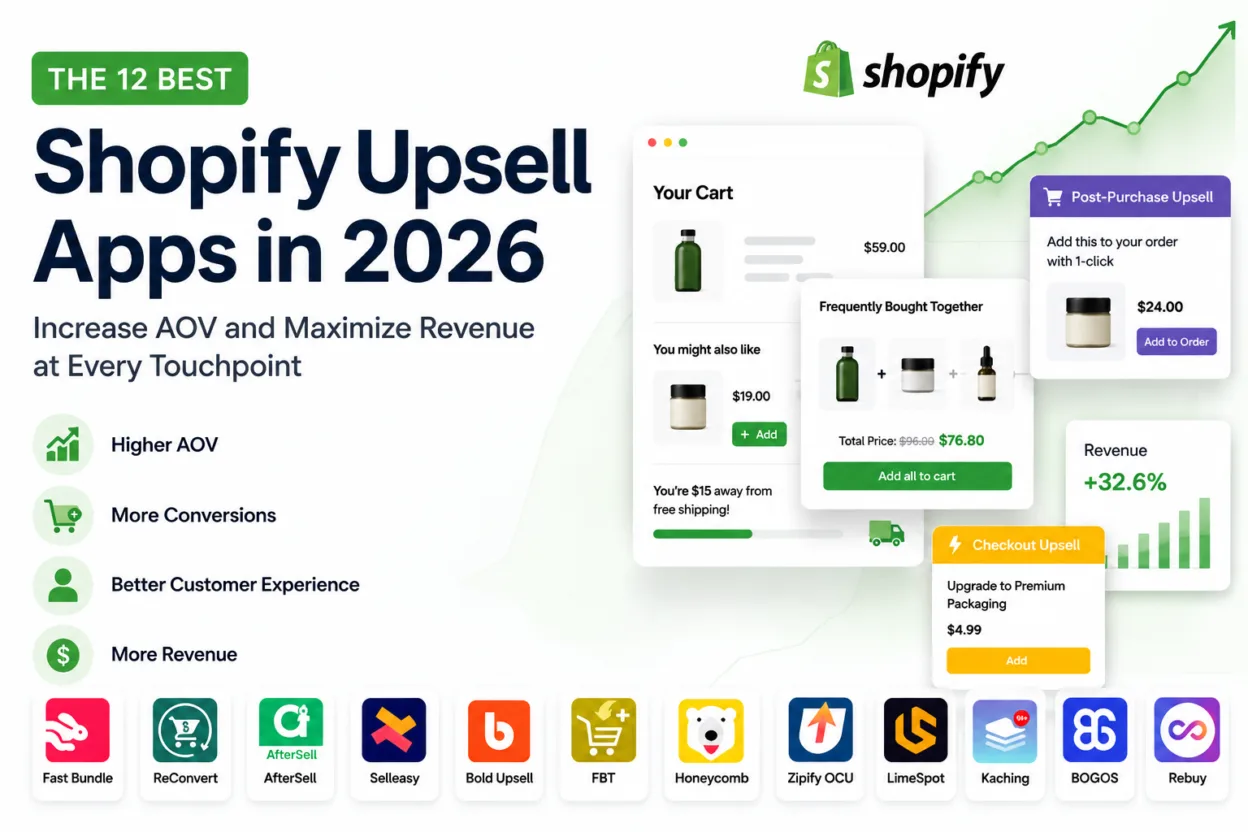
That’s why upsell and cross-sell apps have become essential infrastructure for serious Shopify stores in 2026. If selected correctly, they can lift your AOV by 10-30% without extra traffic costs. But keep an eye on what app you choose and how you do the job, if you don’t do it well, they slow you down and annoy customers. Here’s a quick comparison of the best Shopify upsell apps in 2026 based on pricing, upsell touchpoints, and ideal store size.
| App | Best For | Main Touchpoints | Starting Price | Best Store Size |
| Fast Bundle | Bundle-based AOV growth | Product page, cart | $19/mo | SMB → Enterprise |
| ReConvert | Post-purchase funnels | Thank-you page, post-purchase | $4.99/mo | SMB → Mid-market |
| AfterSell | Checkout + post-purchase upsells | Checkout, post-purchase | $34.99/mo | Mid-market → Enterprise |
| Selleasy | Budget-friendly all-around upsells | Product, cart, checkout | $8.99/mo | Small → Mid-market |
| Bold Upsell | Classic upsell flows | Product, cart | $9.99/mo | SMB |
| Frequently Bought Together | Amazon-style FBT offers | Product page | $9.99/mo | SMB |
| Honeycomb | Funnel-based targeting | Product, cart | $49.99/mo | Mid-market |
| Zipify OCU | Advanced post-purchase funnels | Post-purchase | $79/mo | Enterprise |
| LimeSpot | AI personalization | Sitewide recommendations | $18/mo | Mid-market |
| Rebuy | Advanced customization | Full funnel | $99/mo | Enterprise |
| BOGOS | Promotions + free gifts | Product, cart, checkout | $29.99/mo | SMB → Enterprise |
| Kaching Bundles | Volume discounts | Product page | $14.99/mo | Small → Mid-market |
Take this guide as a resource for doing your best. We cover:
- The real difference between upsell and cross-sell (and why it matters)
- Where upsells are in the customer journey
- The 12 best Shopify upsell and cross-sell apps for 2026, with pros and cons
- How to pick the right app for your size and stage
- Common mistakes that hurt conversion when you do the wrong upsell
- Practical strategies you can deploy this week
Upsell vs Cross-Sell: What’s the Actual Difference?
Many store owners know these two as one, but the difference is actually between an offer that converts and one that can get ignored.
Upselling means offering the customer a more valuable version of what they’re already buying. Like they’re looking at the 16GB phone, you offer the 32GB version. They added the standard plan to their cart; you suggested the premium plan with priority support. The resulting purchase is still one product, but better
Cross-selling means offering a complementary product alongside what they’re buying. They added running shoes to their cart; you suggest moisture-wicking socks. The customer leaves with multiple items with added value.
A simple test: If your offer replaces what’s in the cart, it’s an upsell. If it adds to what’s in the cart, it’s a cross-sell.
Where Upsells Happen in the Shopify Customer Journey
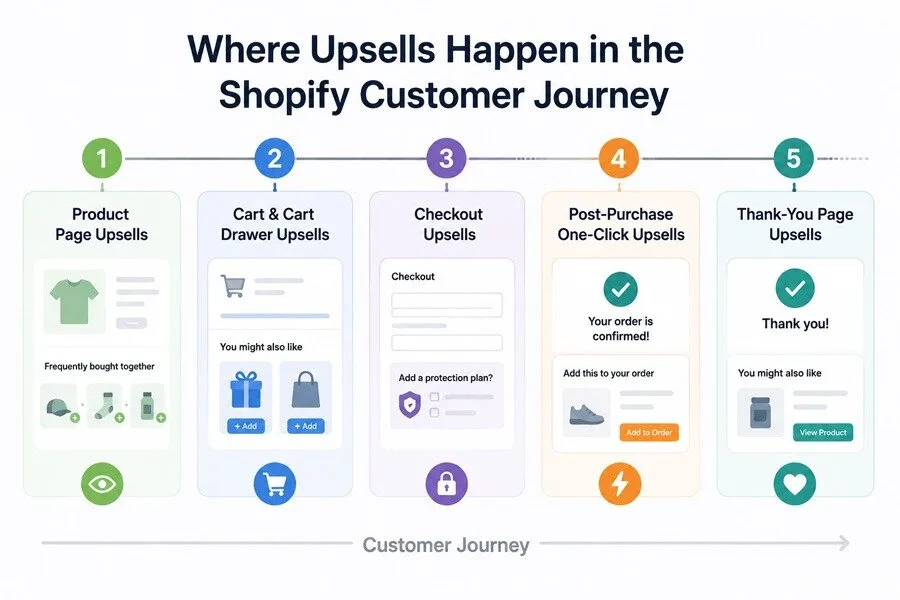
There are five situations where an upsell can show up as an opportunity. Understanding these touchpoints is how you choose the right app, since most of these specialize in one or two of them.
1. Product page upsells. This is where the customer is still considering the purchase. Classic examples: “Frequently bought together” widgets, product variant upgrades, and add-on accessories. There’s no commitment here yet.
2. Cart and cart drawer upsells. Triggered when the customer adds something to the cart or opens the cart (shows intent). This is where “complete the look” suggestions, gift wrapping add-ons, and free shipping bars show up.
3. Check out upsells. Inside the actual checkout page, before payment is made. On Shopify Plus, this is now fully extensible via Checkout Extensibility. On non-Plus stores, your options are limited to specific app blocks.
4. Post-purchase one-click upsells. Immediately after payment, but before the order confirmation page. The customer has just bought, the payment info is stored, and adding another item is a quick job. This can be the highest converting touchpoint.
5. Thank-you page upsells. On the order confirmation page itself. Lower urgency than post-purchase, but still benefits from the momentum.
When you read about an app being “the best Shopify upsell app,” check which of these touchpoints it actually covers.
The 12 Best Shopify Upsell and Cross-Sell Apps for 2026
These apps are ranked by a combination of factors: Shopify App Store rating, real merchant adoption, feature depth, and 2026 relevance.
1. Fast Bundle & Upsell
Best for: Stores that want to grow their AOV with bundles, mix-and-match, and volume discounts.
Rating: 5.0 / 5 (2733 reviews)
Pricing: Paid plans from $19/month based on bundle order volume.
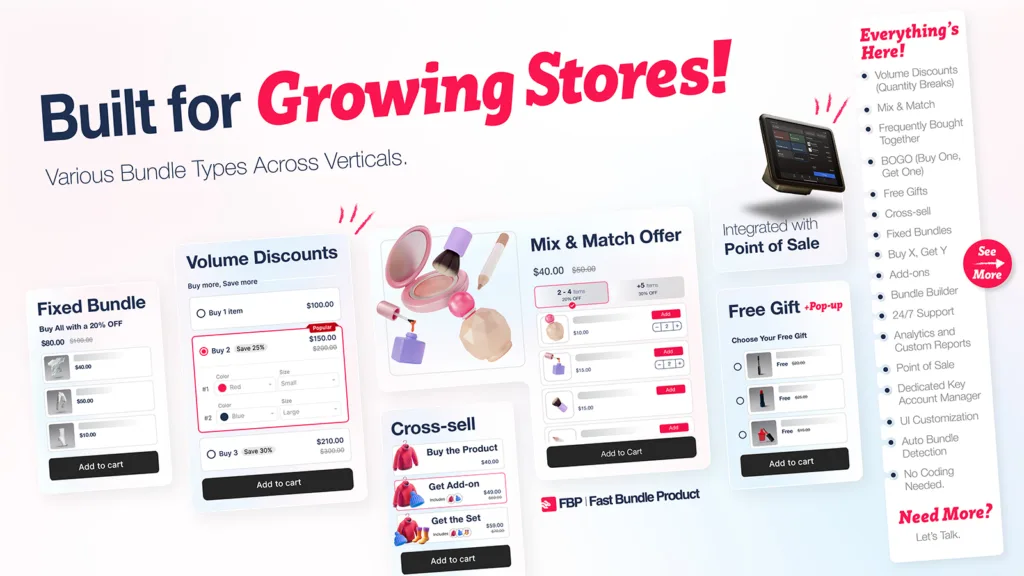
Fast Bundle approaches AOV growth differently from pure post-purchase tools. Instead of offering a separate product at checkout, it builds the upsell into the product page itself through multiple bundle types (like mix-and-match, BOGO, volume discounts, frequently bought together, and add-ons).
This makes Fast Bundle a strong fit for stores where the natural buying pattern involves multiple items (skincare routines, supplement stacks, apparel sets). It’s great for both growing Shopify stores and Shopify Plus merchants with complex catalogs, and is particularly effective when paired with a post-purchase tool like ReConvert or AfterSell. You can see the full feature breakdown on the Fast Bundle Shopify App Store listing.
Pros: Covers most bundle types in one app. Strong support (called out repeatedly in reviews). Built for the Shopify badge.
Cons: Bundle-view-based pricing can scale faster than expected for stores with high product page traffic.
2. ReConvert
Best for: Post-purchase and thank-you page funnels with the largest user base.
Rating: 4.8 (2839 reviews)
Pricing: Paid plans from $4.99/month with revenue share.
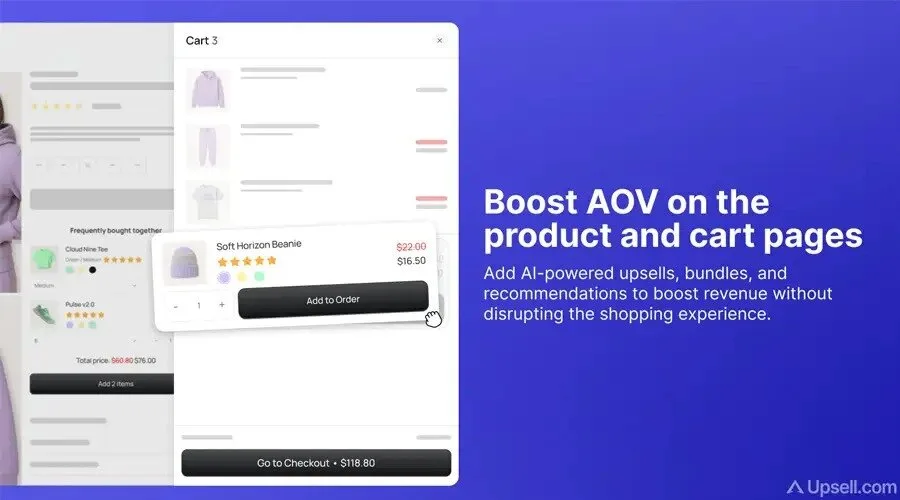
ReConvert is the most-installed upsell app on Shopify, and it’s built around the post-purchase moment. Its drag-and-drop thank-you page editor is the deepest in the category, letting you add product upsells, review prompts, surveys, birthday collection, and social follow buttons to the confirmation page.
The post-purchase one-click upsell funnels support multi-step offers, downsells if the first offer is rejected, and conditional logic based on cart contents or customer attributes.
Pros: Massive review base means a mature, reliable product. Excellent thank-you page editor. Solid A/B testing.
Cons: Revenue-share pricing can get expensive at scale. UI feels dated compared to newer apps.
3. After Sell
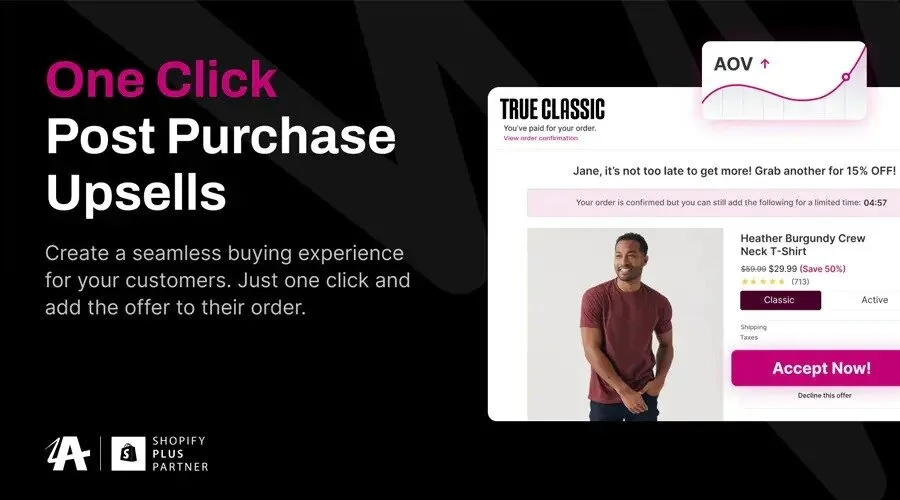
Best for: Shopify Plus stores running native checkout upsells.
Rating: 4.8 (841 reviews)
Pricing: Paid plans from $34.99/month, flat rate (no revenue share).
AfterSell is known for post-purchase upsells, but its 2026 advantage is native Shopify Checkout Extensibility support. For Plus merchants, this app can place offers directly inside the checkout flow with sub-second rendering, something most competitors can’t do without custom development.
The A/B testing and analytics are built around incremental AOV measurement, which is what Plus merchants actually need to justify upsell investments to leadership.
Pros: Best-in-class native checkout integration. Predictable flat-fee pricing. Strong attribution and testing.
Cons: More expensive than alternatives at smaller volumes. Most powerful features require Shopify Plus.
4. Selleasy (by Logbase)
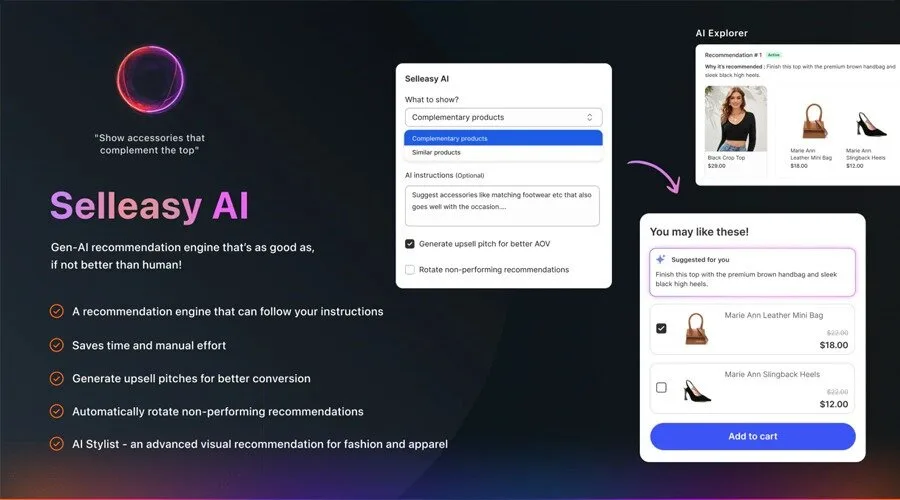
Best for: Multi-touchpoint coverage on a tight budget.
Rating: 4.9 (2363 reviews)
Pricing: Paid plans from $8.99/month.
Selleasy is the most underrated app in this category. It covers most of the touchpoints, from product page to cart and checkout upsells, even thank-you page upsells, all in a single install. Also, the free plan is pretty versatile. The widgets (like FBT) and the cart drawer look clean and native too, alongside a support team that’s known for attentiveness.
Pros: Multi-touchpoint coverage is rare at this price. Clean design. Excellent free tier.
Cons: Fewer “advanced” features (deep AI personalization, complex funnel logic) than enterprise tools.
5. Bold Upsell (by Bold Commerce)
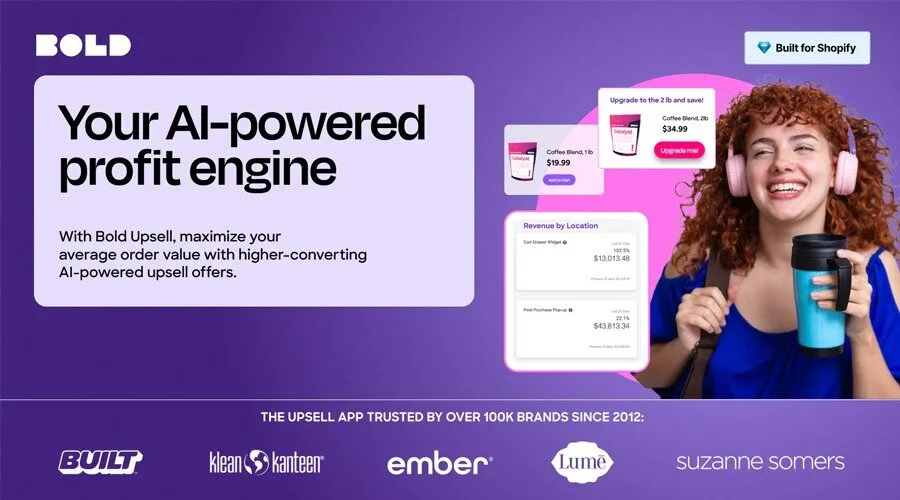
Best for: Established stores wanting a battle-tested classic upsell tool.
Rating: 4.3 (583 reviews)
Pricing: Plans from $9.99/month.
Bold Upsell has been on the App Store longer than most. It’s stable, predictable, and built by a Shopify ecosystem veteran. The dashboard includes both true upsells (replace-cart-item style) and cross-sells.
Pros: Long track record. Familiar interface for merchants who’ve used Bold apps before. Reliable support.
Cons: Feels less innovative than 2026-native competitors. No native Checkout Extensibility for Plus.
6. Frequently Bought Together (by Code Black Belt)
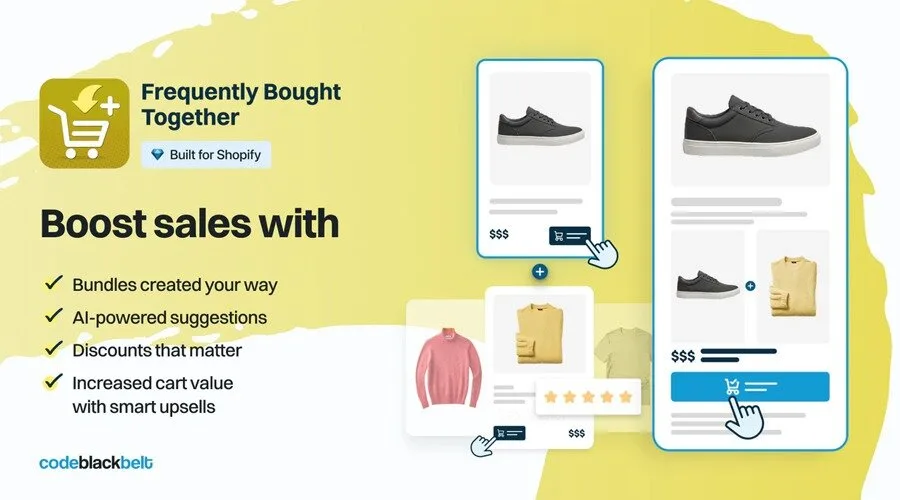
Best for: Stores that just want Amazon-style “FBT” recommendations without complexity. Rating: 4.9 / 5 (1099 reviews)
Pricing: Plans from $9.99/month.
This app does one thing very well: it shows a “Frequently Bought Together” widget on product pages with AI-generated suggestions based on your store’s purchase history. But this is the only option. Although it’s done perfectly, you won’t have any of the common ones like funnel builder, checkout integration, and thank-you page editor.
Pros: Genuinely set-and-forget. AI suggestions improve with data. Lightweight.
Cons: Single-touchpoint app, you’ll need a second app for cart, checkout, or post-purchase upsells.
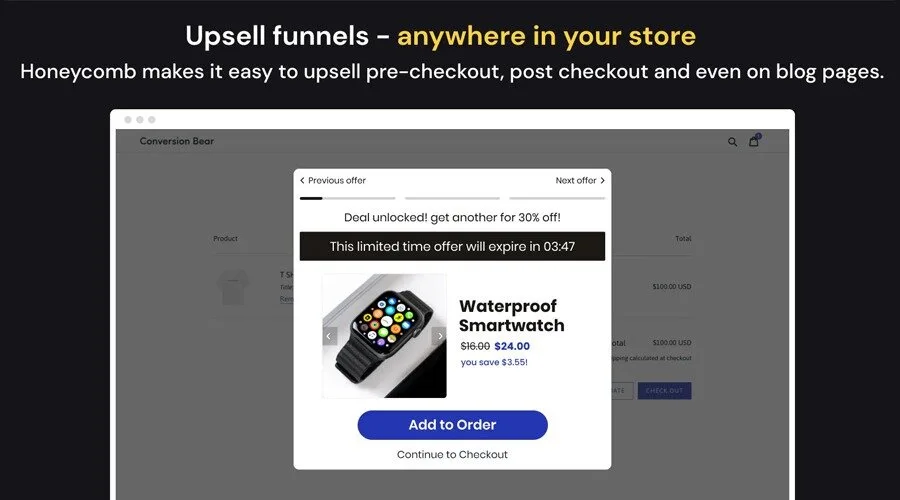
7. Honeycomb Upsell Funnels (by Conversion Bear)
Best for: Pre-purchase and in-cart upsell funnels with strong targeting.
Rating: 4.8 (150 reviews)
Pricing: Paid plans from $49.99/month.
Honeycomb focuses on the pre-purchase and in-cart funnel, with conditional logic (show offer X if cart contains Y) and rules-based targeting. The visual funnel builder is one of the best in the category.
Pros: Excellent funnel logic. Free plan covers up to 100 funnel views.
Cons: Higher monthly price at scale. Less depth on post-purchase compared to ReConvert or AfterSell.
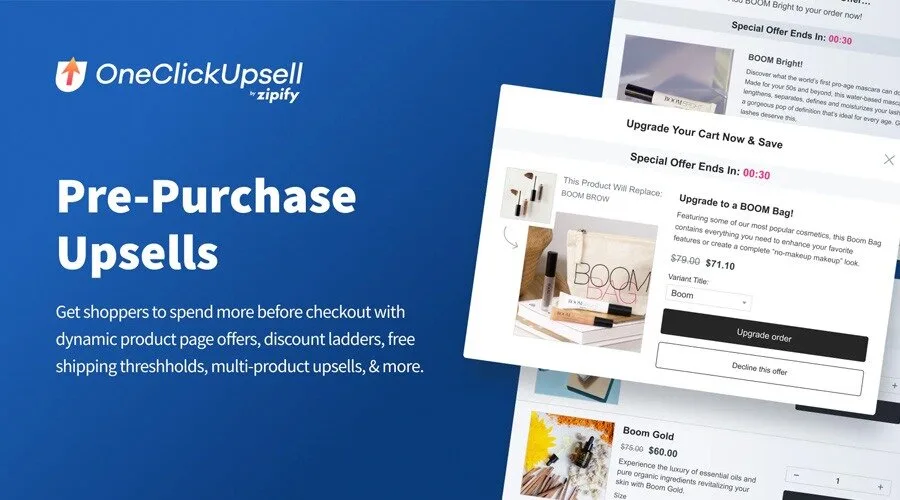
8. Zipify One Click Upsell
Best for: Stores running aggressive post-purchase funnel testing.
Rating: 4.5 (518 reviews)
Pricing: Plans from $79/month.
Zipify OCU is the heavyweight, but super versatile. An option built by Ezra Firestone’s team. It’s expensive, but for stores doing serious post-purchase volume, the options are unmatched: depth of split testing, segmentation, and offer logic.
The trade-off: you’ll feel the price below ~$50K/month in revenue.
Pros: Industry-leading post-purchase funnel depth. Trusted by 8- and 9-figure stores.
Cons: Pricing puts it out of reach for smaller stores. Steeper learning curve.
9. LimeSpot Personalizer
Best for: AI-driven recommendations across the entire store.
Rating: 4.6 (494 reviews)
Pricing: Plans from $18/month.
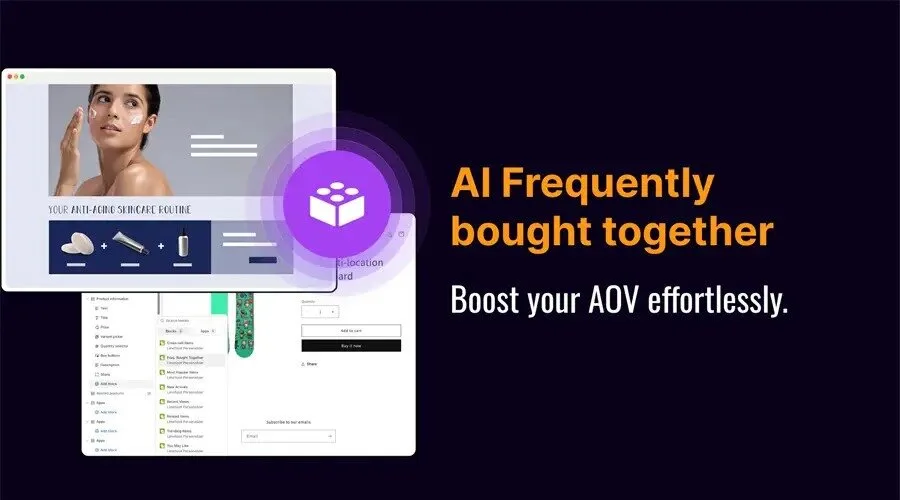
LimeSpot uses AI to power product recommendations everywhere, from homepage and collection pages to product pages, cart, and email. If you’re optimizing for personalization rather than specific upsell moments, LimeSpot covers more surface area than most apps.
Pros: True AI personalization. Multi-channel coverage, including email.
Cons: Less control over specific offer logic than rules-based apps. Pricing scales with traffic.
10. Rebuy Personalization Engine
Best for: Shopify Plus stores wanting deep customization and developer control.
Rating: 4.7 (818 reviews)
Pricing: Plans from $99/month.
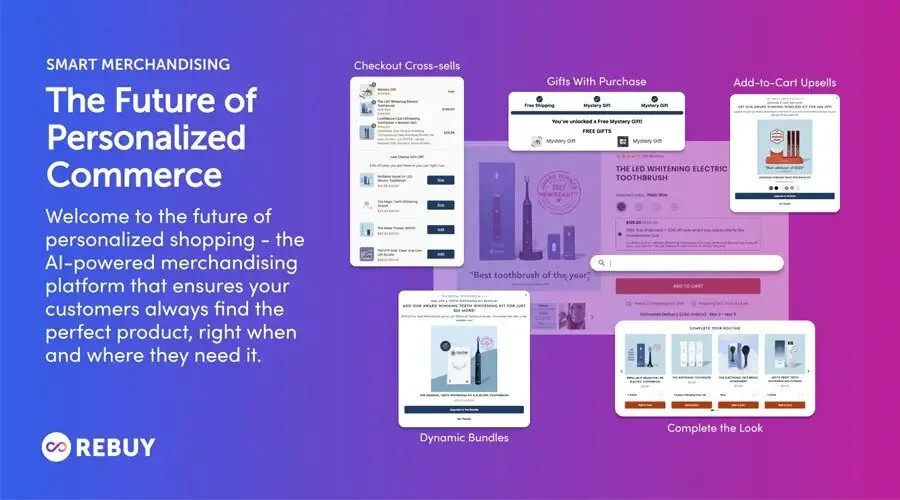
Rebuy is the developer’s choice. It has a powerful Liquid-based widget system that lets you build virtually any upsell flow you can imagine, but you’ll need someone comfortable with Liquid templates to unlock its potential. For Plus stores with in-house developers, Rebuy can replace three or four-point solutions.
Pros: Maximum flexibility. Strong subscription and post-purchase coverage. Plus-friendly. Cons: Steepest learning curve in this list. Overkill for smaller stores.
11. BOGOS | Free gift Bundle Upsell
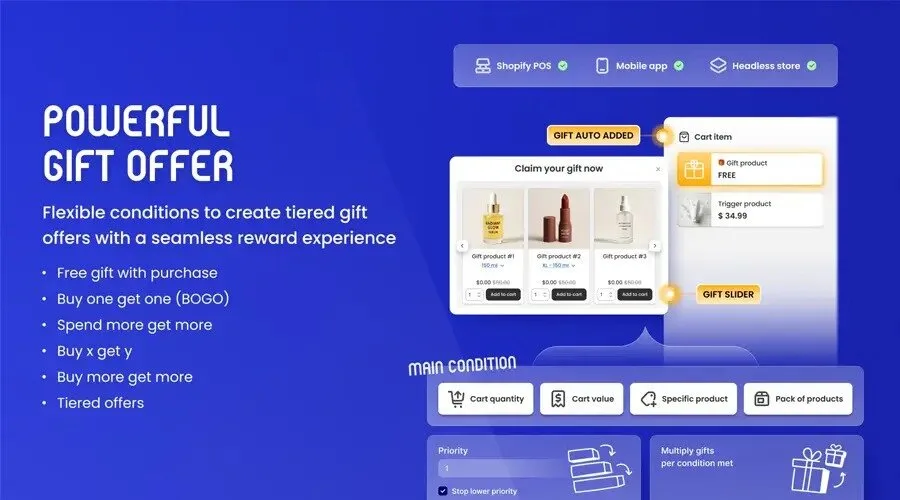
Best for: Free gifts and upsells on basic and Plus with a simple setup.
Rating: 5 (3782 reviews)
Pricing: Plans from $29.99/month.
A flexible AOV app built around how merchants actually run promotions. Set up free gifts with purchase, BOGO offers, mix-and-match bundles, or build-a-box experiences, then layer in volume discounts and checkout upsells where it matters.
Pros: All-in-one promotion toolkit, Native Plus & headless support, highly customizable targeting rules
Cons: Plus pricing is high, has a learning curve
12. Kaching Bundles
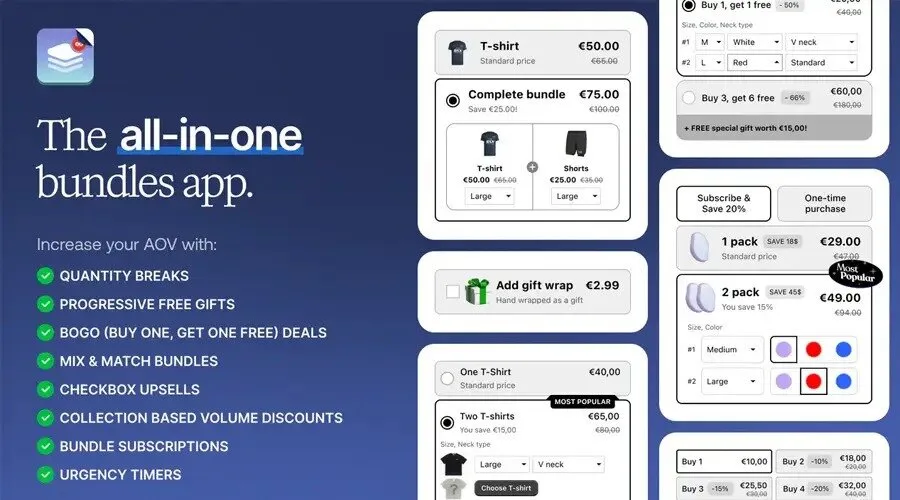
Best for: Volume discount and quantity-break upsells.
Rating: 5.0 (4388 reviews)
Pricing: Paid plans from $14.99/month.
Kaching has built a loyal following by focusing on volume-discount-style bundles. It integrates with page builders like Instant for stores running custom landing pages. The free plan, up to $1,000 in generated revenue, makes it easy to test.
Pros: Excellent free tier. Strong on quantity-break psychology. Highly rated support.
Cons: Less versatile than full-feature bundle apps. Narrower use case.
How to Pick the Right Upsell App for Your Store
The “best” app depends entirely on you. The stage you’re in, your Shopify plan, and which touchpoint you need to cover. Use this framework:
If you’re under 100 orders/month: Start with Selleasy (free) or Kaching Bundles (free up to $1K revenue). You need to learn what your customers respond to before paying.
If you’re between 100-1,000 orders/month and want one app to handle most upsells: Look at ReConvert for post-purchase focus, or Fast Bundle if your bundles aim to grow AOV.
If you’re between 1,000-10,000 orders/month with a clear AOV strategy: This is where you need to specialize. Run a bundle app (Fast Bundle, Kaching) for pre-purchase + a post-purchase tool (ReConvert, AfterSell) for after-checkout.
If you’re on Shopify Plus: AfterSell or UpsellPlus for native checkout extensions. Add Rebuy if you have developer resources and want maximum customization. For the brand-side bundle strategy, Fast Bundle’s Plus-tier features handle complex catalogs without dev work.
If you’re at 10,000+ orders/month or 8/9-figure revenue: Run Zipify or Rebuy for deep funnel logic, layer in dedicated bundle infrastructure, and build internal testing capabilities.
Common Upsell Mistakes That Hurt Conversion
Adding an upsell app doesn’t automatically increase AOV. Your results can be tackled if you make these mistakes:
Showing irrelevant offers. A customer buying running shoes doesn’t need a kitchen blender. Generic offers hurt trust. Always add offers to the cart context.
Stacking too many touchpoints. Product page + cart + checkout + post-purchase + thank-you upsells = an exhausted customer. Pick the 2-3 highest-value moments and execute them well; don’t overdo it.
Slow widgets. Upsell apps that inject huge JavaScript code can add 1-3 seconds to your page load. For mobile users, that can lead to losing the sale. Test with PageSpeed Insights before and after install.
Discount-first upsells. “Add this for 30% off” trains customers to expect discounts. Use them sparingly. Often, a relevant product at full price converts better than a random product at a discount.
Over-aggressive post-purchase offers. The customer just bought and feels good. A high-pressure timer hurts that. Keep post-purchase upsells calm.
Ignoring mobile. Most Shopify traffic is mobile. If your upsell modals don’t render cleanly on a phone, you’re losing 60%+ of potential upsell revenue.
Practical Upsell Strategies That Actually Work in 2026
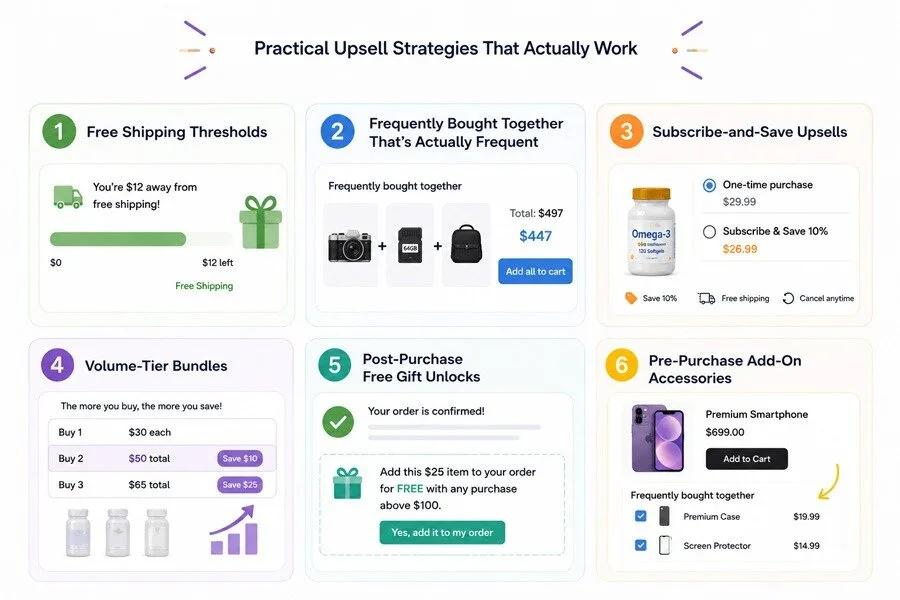
Beyond app selection, these are the strategy moves that separate stores with strong upsell programs from those that do random work.
Free shipping thresholds. “You’re $12 away from free shipping” is the most reliable cart upsell pattern in ecommerce. Set the threshold 15-25% above your current AOV.
Frequently bought together, that’s actually frequent. Don’t just put random products in an FBT widget. Use real purchase data and the right app.
Subscribe-and-save upsells. For consumables, offer “subscribe and save 10%” on the product page. This converts a one-time order into recurring revenue.
Volume-tier bundles. “Buy 1 for $30, 2 for $50, 3 for $65”, visualize the savings clearly. Fast Bundle and Kaching both excel at this format.
Post-purchase free gift unlocks. “Add this $25 item to your order for free with any purchase above $100,” works especially well at the post-purchase moment.
Pre-purchase add-on accessories. Cameras need SD cards. Phones need cases. Skincare needs sunscreen. Cross-sells of necessary accessories convert at 8-15%, much higher than random recommendations.
Does Shopify Have Native Upsell Features?
Shopify has been adding native upsell capabilities, but in 2026, they’re still limited compared to apps:
- Shopify Bundles (native app) handles fixed bundles and multipacks, lacks logic and cross-sell.
- Checkout Extensibility (Plus only) opens the checkout page for upsell apps to extend, but Shopify itself doesn’t offer upsell widgets.
- Shopify Magic (AI features) includes basic product recommendations on collection pages but no full-funnel logic.
Final Recommendations
If you’re trying to make a single choice and don’t want to read the whole list again:
- Best free option: Selleasy
- Best post-purchase app: ReConvert
- Best Shopify Plus checkout app: AfterSell
- Best bundle-based AOV app: Fast Bundle
- Best AI personalization: LimeSpot
- Best enterprise/dev-friendly: Rebuy
Whatever you pick, install one app, run it for 30 days, measure incremental AOV, and only then layer in additional tools.
FAQ
1. What’s the difference between an upsell and a cross-sell? An upsell offers a more expensive version of what’s already in the cart. A cross-sell offers a complementary product with it.
2. Are post-purchase upsells worth it? Yes, if implemented well. Post-purchase is the highest-converting upsell moment on Shopify because payment is already captured, and adding an item is one click.
3. Do I need a paid upsell app, or is a free one enough? For stores under 50 orders/month, Selleasy’s free plan covers the basics. Above that, paid apps pay for themselves with even a modest AOV lift.
4. Will upsell apps slow down my Shopify store? Some will. Apps that inject heavy JavaScript on the product page can add 1-3 seconds to load time.
5. Can I run multiple upsell apps at once? Yes, but be selective. The common setup is: one bundle/pre-purchase app + one post-purchase app.
6. What about Shopify Plus checkout upsells specifically? Plus stores can use Checkout Extensibility to place upsells natively inside the checkout flow. AfterSell and UpsellPlus are the strongest options here.
7. How much can upsells realistically lift my AOV? Well-implemented upsell programs typically lift AOV by 10-30%. The high end requires multi-touchpoint coverage.