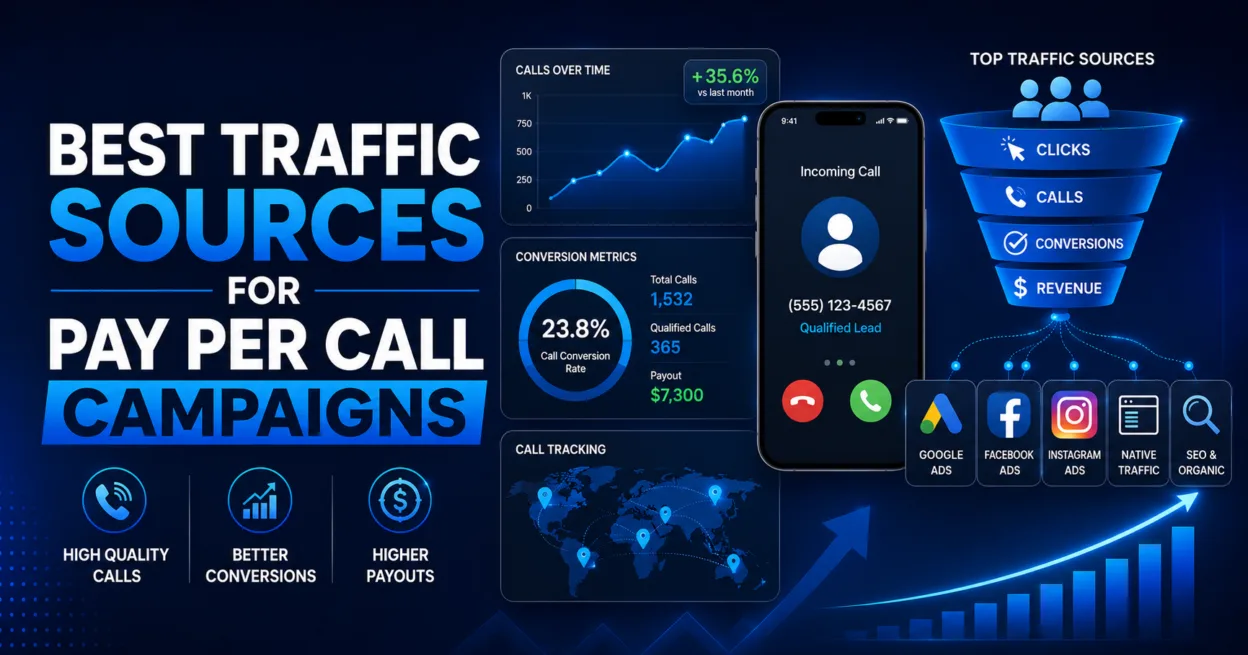
Pay per call marketing is easily among the most effective ways to generate high-intent leads, performing particularly well in urgent niches. In fact, it’s also great for aspiring businesses. When paired with affiliate marketing, pay per call incurs costs only upon conversions, allowing you to attract your first clients risk-free.
Pay per call, however, doesn’t perform the same way across channels. In fact, channel choice affects how you structure pay per call campaigns, set bids, and measure performance.
Google Ads
Search advertising on Google is the default starting point for pay per call marketing campaigns. People who are ready to call have already passed most of the funnel and are ready to take action.
Google Ads supports dedicated campaigns in which the ad displays a phone number; when the user taps it, the number is transferred to their calling app, where they can either connect or abandon the call.
In terms of bidding, users typically start with manual cost per click (CPC). However, as you accumulate enough historical data, you can switch to cost per action (CPA) bidding, a smart model that automatically optimizes ads for conversions.
A few things that directly affect Google Ads performance:
- Call campaigns show exclusively on mobile devices. The format is built around the tap-to-call mechanic on smartphones.
- Geographic targeting matters more than most advertisers treat it. Narrower targeting produces more relevant leads, particularly in service-area businesses.
- Keyword targeting is tremendously important. Poor keyword strategy can waste budget and drag down CTR.
- Quality Score – a combination of your CTR data, intent matching, and landing page quality – determines how much you pay for a tap on the ad. A higher score means a lower CPC for the same placement.
By design, Google Ads call campaigns target high-intent prospects. However, to maximize their profitability, you should support account hygiene by regularly refining campaigns.
Facebook and Instagram Ads
With Meta ads, in turn, you can reach users who haven’t committed to active search yet. Meta builds a behavioral profile for each user based on what they engage and interact with across its platforms. When a paid ad appears in that feed, it’s because Meta’s algorithm flagged that user as a likely match for the offer.
That makes Facebook and Instagram better suited as upper- or mid-funnel channels, driving calls through the following tactics:
- Warming up a cold audience.
- Running ads to website visitors who didn’t convert.
- Targeting users who share characteristics with your existing customers.
Facebook does support click-to-call ads natively. It makes lead generation campaigns with a phone number as the primary CTA, or mobile-only traffic campaigns with a call button, viable and effective. These tend to perform best in niches where decisions are made quickly or under some kind of urgency.
Retargeting as a Multiplier
Retargeting is where Facebook earns a special place in pay per call marketing. A user clicks a Google Ad, lands on the page, and leaves without calling. Later, they may start to explore the topic deeper, which may involve watching Reels or joining specific groups on Facebook.
Facebook retargeting lets you reach users who have already seen or somehow engaged with your brand. It creates a sense of familiarity, making users more inclined to dial your number.
Native Advertising
Platforms like Taboola, Outbrain, and MGID serve ads that look like recommended articles. They run on news sites and large media properties, sitting alongside editorial content.
Native ads sit closer to the top of the sales funnel. That longer path is offset by significantly lower CPC. The channel works best in niches where people take weeks to make a decision. Educational articles fit naturally here because users in the research stage are actively looking for that kind of content.
There is also a brand familiarity effect. A user who reads your article today and does not call is still a prospect. Next time they see your name on Google or Facebook, they’ll remember you – an effect that makes the next touchpoint more effective.
Affiliate Marketing
In this case, you pay only when a qualifying call comes in. If the affiliate doesn’t generate a qualified call, you pay them nothing. That is a fundamentally different arrangement from a sponsored post, where you pay upfront regardless of results.
In affiliate marketing, you can work with publishers via a network or manage them directly. The first option is simpler, but limits your visibility into what sources generate calls. The second option takes longer to build, yet you’ll get full transparency and more flexibility with terms.
Call Tracking and Analytics
Regardless of which traffic sources you use for your pay per call marketing campaigns, most of your success depends on your tracking setup. Without it, there is no way to tell which channel is delivering quality calls and which is just burning your budget.
Here is how call tracking platforms can help you:
- Tie every inbound call to a specific traffic source, campaign, keyword, or ad.
- Record calls so you can filter out short or irrelevant conversations and understand how to make your promotions even better.
- Route calls automatically between different reps.
- Receive reports on conversion rates, answer rates, and call durations in real time.
- Detect invalid, duplicate, or incentivized calls.
- Connect call data with downstream sales and revenue outcomes via CRM integrations.
Full-featured pay per call software offers even broader capabilities. Aside from tracking, it covers campaign management: building offers, handling publisher relationships, automating payouts, catching fraud, and connecting to ad platforms via API. The less time you spend managing all that manually, the more time you have to actually act on what the data is telling you.
How To Choose the Right Channel Mix
There is no universal answer to which traffic source works best for pay per call marketing in your case. The right mix depends on your niche, budget, expected scale, and how long you are willing to wait before seeing returns.
Most businesses start with Google Ads, and for a good reason. The intent is there from the first click. Once you have that baseline, you can start layering other channels:
- Facebook and Instagram make sense for audiences who are not yet ready to search but are already thinking about the problem.
- Native advertising brings in volume at a lower cost, which works well in niches where people take weeks or months to make a decision.
- Affiliate partnerships make sense once you have a clear benchmark for what constitutes a qualifying call.
Whatever the mix, you need to have a reliable call tracking toolkit with full attribution. Without it, you cannot tell which campaigns are producing valuable calls and which ones you need to rethink. Good call tracking connects every inbound call to the source, campaign, and keyword that drove it, allowing you to make spot-on optimization decisions rather than relying on guesswork.