
TL;DR – Key questions this article answers
- Which vendors are considered the best legacy system modernization partners for operational companies in FinTech in USA today?
- What exactly is legacy modernization FinTech, and why is it urgent in 2026?
- Which modernization types – rehosting, refactoring, replatforming, rebuilding, or replacing – fit different risk-reward profiles?
- What capabilities separate an average vendor from a top-tier legacy system modernization company?
- How do Techstack, Hexaview Technologies, Publicis Sapient, Infosys, ScienceSoft, Keyhole Software, and Cognizant compare for U.S. banking and FinTech scenarios?
- Which technologies and architectures matter most for regulated financial workloads?
- What measurable business benefits have firms gained from legacy fintech application modernization?
Introduction
A decade ago, “move fast and break things” sounded exciting. In 2026, breaking things in financial services is a one-way ticket to an OCC consent order and a front-page headline you never wanted. U.S. FinTech founders, CTOs, and banking technology heads now sit on a paradox: they must innovate at speed while guaranteeing reliability that regulators, auditors, and customers can trust. Legacy monoliths, fat ERP plugs-on, and 1990s mainframes are in the way. Each quarter without a plan consumes engineering capacity, increases infrastructure expense, and makes security audit more difficult.
That danger is why legacy system modernization services for fintech companies have moved from back-office talk to board-level mandate. Modernizing is no longer a “someday” project but a present-day prerequisite to unlock cloud elasticity, real-time data, and AI-driven personalization. Choosing the right partner determines whether modernization delivers sustainable advantage or becomes a multi-year sinkhole.
What Is Legacy System Modernization in FinTech?
Few technology phrases attract more interpretations, so it helps to anchor on first principles before diving into tactics.
Definition of Legacy Modernization FinTech
Legacy modernization in FinTech is the discipline of transforming mission-critical but aging financial software so it can operate securely, scale elastically, integrate via APIs, and support continuous delivery without losing business logic or regulatory compliance in the process. Work can span code conversion, data migration, interface redesign, and full architectural overhaul, yet the business objective remains the same: keep money moving while bringing systems into the modern era.
Why FinTech Companies in the USA Modernize Legacy Systems
U.S. FinTech firms modernize for measurable reasons, not buzzwords. Each typically points to one or more of the following drivers:
- Cost and margin pressure. Gartner estimates legacy platforms consume 70% of run-the-business IT budgets in midsize banks.
- Growth ceilings. There are batch-based settlement and hard-coded limits, which limit the number of transactions that can be processed, thus slowing customer acquisition.
- Security exposure. Unsupported middleware is not patched by the vendor, increasing the attack surface and violating NYDFS Part 500 guidelines.
- AI roadblocks. Data trapped in siloed mainframes cannot feed GenAI credit-risk engines or fraud-detection models.
Modernization addresses each pain point in incremental, low-risk waves, a theme we will revisit when discussing legacy system modernization firms.
Common Challenges of Legacy FinTech Infrastructure
No two codebases are identical, but the obstacles rhyme:
- Opaque dependencies – spaghetti integrations mean one field change in a COBOL copybook breaks three downstream processes.
- Monolithic release cadence – big builds every other month makes it difficult to do rapid A/B experimentation.
- Compliance bottlenecks – manual evidence collection makes audits 12 weeks of fire drills.
- Skills shortage – every year more mainframe engineers retire, making support harder.
Good modernization programs assemble mapping tools, automated tests, and DevSecOps pipelines to neutralize each challenge before production cut-over.
Types of Legacy FinTech Application Modernization
Before selecting tooling, leaders need to match modernization style to business context. Each “R” carries unique cost, timeline, and risk. Skipping this analysis is a top reason projects derail.
| Modernization Type | Typical Effort | Main Benefits | Trade-offs | When to Choose |
| Rehosting | Low | Quicker cloud migration, hardware savings | Technical debt mostly intact | When time-to-cloud is critical and code health is acceptable |
| Refactoring | Moderate | Better maintainability, modular code | Requires strong automated tests | When monolith hinders feature velocity |
| Replatforming | Moderate | New runtime features, CI/CD enablement | Some code change required | When libraries are obsolete but logic remains valid |
| Rebuilding | High | Cloud-native scalability, event driven | Highest upfront cost | When architecture blocks scale or security |
| Replacing | High | Proven vendor functionality | Potential lock-in | When core ledger isn’t a differentiator |
Rehosting
Rehosting is sometimes referred to as “lift-and-shift.” Teams wrap up existing VMs or mainframe workloads in IaaS without extensive code changes. It is an excellent way to reduce data-center leases and hardware refresh costs rapidly. However, if architectural inefficiencies still exist, cloud costs may go up with an unoptimized lift-and-shift.
Refactoring
Refactoring modifies internal structure – splitting services, improving domain boundaries – while maintaining external behavior. It is common in legacy fintech application modernization programs that aim to shorten release cycles and inject test automation. Containerization and refactoring are usually used together in order to have operational consistency.
Replatforming
Replatforming is the process of moving applications to the new runtime environments like Java 21+, .NET 10, Spring Boot or Kubernetes. This brings about benefits such as enhanced security patching, autoscaling, and cloud-native observability. It requires regression testing and offers benefits by enabling modern DevOps workflows.
Rebuilding Legacy Financial Applications
Rebuilding is a reset and is typically written in a cloud-native stack. Development is broken up into domain features, and data is pushed out to distributed data stores like CockroachDB or Google Spanner. The benefits, such as sub-second payments and AI personalization, are pretty impressive, but the danger is when the team doesn’t possess the deep domain expertise.
Replacing Core Systems
Replacement swaps proprietary or in-house code for commercial SaaS or packaged banking engines. Banks opt for this when differentiation does not live at the ledger layer. Vendors’ roadmaps, open-banking API maturity and exit clauses should be part of due diligence.
What Makes a Strong Legacy System Modernization Partner?
The market lists hundreds of vendors, but only a subset exhibits the multidisciplinary depth to de-risk regulated workloads at scale.
FinTech Domain Expertise
Payment routing, ACH settlement and credit bureau integration seem simple until edge cases emerge. The first time, a partner familiar with these flows foresees potential problems, adding in proper control points.
Regulatory & Security Knowledge
Like a set of dolls, SOC 2, ISO 27001, PCI DSS, GLBA, GDPR and state privacy laws all nest. A firm specializing in legacy system modernization must weave these mandates into CI/CD pipelines, not bolt them on late. Reduce audit cycles by 50% with evidence automation.
Enterprise Architecture Capabilities
Legacy code is seldom a good fit for microservices’ boundaries. With domain-driven design, event sourcing and CQRS, architects avoid rework that is expensive. They make decisions and clearly record them so that the operation teams can continue with them.
Cloud & DevOps Expertise
Immutable infrastructure, Infrastructure-as-Code and Policy-as-Code are no longer optional. The partners should have hands-on experience with Terraform, AWS Control Tower, Azure Landing Zones, Kubernetes operators and GitOps workflows to prevent post-go-live firefighting.
Proven Experience With Operational Companies
Modernizing a marketing site is one thing; migrating a system that reconciles billions in card settlements is another. References from an operational company in FinTech in USA prove the partner copes with round-the-clock load, real money movement, and regulator scrutiny.
Best Legacy System Modernization Companies for FinTech in the USA
Here are seven legacy system modernization companies that are continually being shortlisted by U.S. financial institutions.
1. Techstack – Best for AI Readiness and Cost-Driven Modernization
Source: Techstack
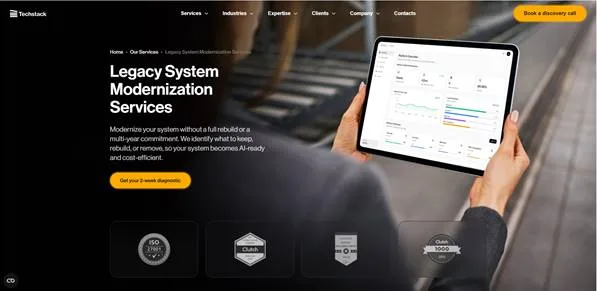
Techstack has experience in redesigning, rebuilding, migrating and optimizing a legacy software without a replacement. Engagements begin with a 2-week diagnostic to identify architecture dependency, data flows and cost drivers. The team recommends a series of small, outcome-driven sprints, based on findings, to deliver one of three service tracks, including AI readiness, cloud migration, or full modernization. Techstack’s clients value the fact that the company does not subscribe to a one-size-fits-all playbook. Most systems are AI-enabled through incremental API enablement and data-layer refactoring, not rewriting.
One of Techstack’s FinTech clients experienced a 30% acceleration in development speed thanks to a .NET monolith being migrated to .NET 6 and a component-oriented architecture. Operational costs were cut by up to 3 times with DevOps automation. A testimony to its compliance prowess, Techstack is ISO-certified, fully GDPR-compliant, and experienced with PCI DSS.
2. Hexaview Technologies – Best for Mainframe-Heavy FinTechs and COBOL Modernization
Source: Hexaview Technologies
Hexaview Technologies is a U.S.-based expert with a razor-thin focus: regulated industries such as FinTech, wealth management and banking, where codebases from the COBOL era and compliance requirements meet. The firm’s proprietary LegacyCodeBench benchmark, developed in collaboration with applied AI research lab Kalmantic, evaluates AI comprehension of COBOL – the language still processing 95% of ATM transactions globally. Hexaview’s Legacy Insights tool scored 92% accuracy on that benchmark, outperforming general-purpose models, which translates directly to fewer surprises during code migration. Engagements are based on a senior-led, “decoupling before moving” approach: the business logic is removed, verified and retained, and no workload is moved to the cloud.
Hexaview’s AI-assisted conversion can achieve 95-98% code-to-spec accuracy and zero-downtime transitions for banks transitioning from COBOL, BASIC, and AS/400-based systems. Examples of documented client results are a 60% performance gain, a 50% decrease in infrastructure costs for a wealth management company, and compliance signoff that was maintained throughout. A credible alternative to large system integrators for mid-market U.S. The firm is certified to SOC 2 Type II and is ISO 27001 compliant, serving FinTechs, wealth management and banking firms.
3. Publicis Sapient – Best for Enterprise-Scale Digital Transformation Programs
Source: Publicis Sapient
Publicis Sapient is uniquely positioned to handle large-scale multi-application modernization efforts in the financial services industry by operating at the intersection of business strategy and engineering implementation. Its SPEED approach (Strategy, Product, Experience, Engineering, and Data and AI) is a holistic, end-to-end approach and not handed down between consulting and delivery teams. It has an agentic AI that automates code conversion, test generation and SDLC acceleration for legacy modernization with up to 99% code-to-spec accuracy for mainframe and monolithic stacks via its Slingshot platform. In addition, it announced a five-year global strategic collaboration agreement with AWS in 2025 to bolster its ability to migrate financial workloads to the cloud while providing cost management from the ground up.
Publicis Sapient’s financial services track record spans helping a major U.S. bank scale GenAI implementation, launching a digital-only banking entity in the cloud for a UK bank, and building an end-to-end wealth management platform for a large U.S. custodian. The firm’s Bodhi AI platform, built on Amazon SageMaker and Amazon Bedrock, gives compliance-sensitive FinTechs enterprise-grade safeguards and responsible AI guardrails alongside model flexibility. Engagements typically suit organizations with multi-business-unit scope and multi-year budgets, where the value of a unified strategy-to-engineering partner outweighs the cost premium.
4. Infosys – Best for Modernization at Offshore Scale
Source: Infosys
Infosys provides enterprises with modernization at a scale and cost that they would not be able to manage themselves if they had to coordinate across the global time zones. The Infosys Modernization Suite enables provisioning of AI-powered code analysis, code refactoring suggestions, and scaffolding for microservices. To speed up cloud migrations, Infosys Cobalt has pre-built reference architectures and accelerators for FFIEC compliance. Often banks with Infosys would point to the fact that they can save 30-40% compared to purely onshore models with good governance and defined sprints.
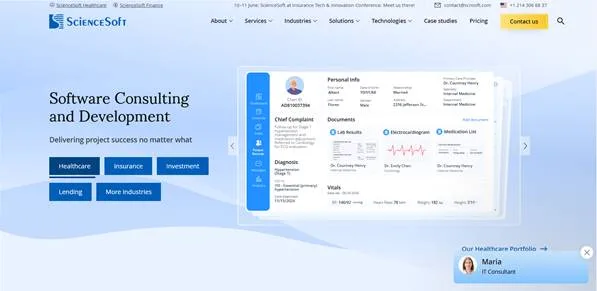
5. ScienceSoft – Best for Mid-Market Custom Application Modernization
Source: ScienceSoft
Fortune 500 budgets are not always available at midsize banks and FinTechs in the U.S., and yet audited processes are required. ScienceSoft fills in that gap with ISO 9001 and 27001 certifications, transparent resource allocations and fixed-price statements of work. Case studies are examples of .NET and Java monoliths that were replaced with AWS Fargate microservices, reducing release cycles by 60% and infrastructure costs by 35% per year. The predictable pricing, combined with ScienceSoft’s expertise in HIPAA and PCI DSS makes the company an attractive option for compliance-focused FinTechs.
6. Keyhole Software – Best for Engineering-Led Modernization with Deep Architecture Expertise
Source: Keyhole Software
Keyhole Software is a U.S.-based boutique whose consultants average 17+ years of professional experience — the highest documented figure in multiple 2026 vendor surveys. That seniority matters enormously in legacy environments, where architectural judgment separates a clean migration from a costly do-over. Founded in 2008, Keyhole has spent nearly two decades building and modernizing financial software, with hands-on experience in payment processing, securities trading, and core banking modernization. Its engineers specialize in microservices architecture, cloud-native development, and the kind of structured migration blueprints that allow teams to deploy on-premise and in Azure without rewriting the same logic twice.
7. Cognizant – Best for Industry-Specific Modernization at Regulated Enterprises
Source: Cognizant
Cognizant’s Neuro IT platform is a combination of infrastructure automation and application modernization tooling. Cognizant provides domain accelerators for loan origination, KYC and payment switching, all compliant with the SOC2 Type II and FedRAMP requirements in financial services. 85% of executives in a 2025 Cognizant survey of 1,000 executives around the world reported that a lack of AI adoption is hindered by legacy systems. Cognizant’s methodology embeds the AI readiness activities, such as data cataloging and feature engineering pipelines, as part of the cloud migration sprints so that FinTechs come out with machine-learning-friendly architectures.
How to Choose the Right Legacy Enterprise System Modernization Firm
When choosing from legacy system modernization companies, you have to consider ambition, risk appetite, and budget. Decision makers should use a filter process:
Define business goals clearly. Want to cut costs, increase resilience, add AI capabilities or accelerate time to market? Having clear priorities helps avoid scope creep and manage vendors’ expectations.
Then map the current estate – technologies, integration patterns, compliance mandates and key person dependencies. This base will allow proposals from vendors that are apple-to-apple, not slide decks with general information. Use these 5 filters only then:
- Domain fit. Find out whether case studies meet regulations and transaction loads that are similar to yours.
- Methodology transparency. Ask for samples of deliverables from the discovery, architecture and testing stages.
- Toolchain maturity. Partners should demonstrate proven infrastructure-as-code templates, automated regression suites, and policy-as-code libraries.
- Commercial alignment. Mid-market firms may prefer a milestone-based fixed fee; large banks might accept time and materials if governance disciplines spend.
- Post-go-live support. Verify site-reliability engineering coverage and disaster-recovery runbook ownership.
By scoring each candidate, CTOs build a defensible recommendation for the board and regulators alike.
Technologies Used in Legacy System Modernization
Modernization success relies on tooling that balances performance, security, and developer productivity.
Modern cloud providers have matured confidential computing features – AWS Nitro Enclaves, Azure Confidential Ledger, and GCP Confidential VMs – that permit sensitive financial workloads to embrace the public cloud without contravening OCC or CFPB guidance. Container platforms such as Kubernetes now integrate Sigstore-based supply chain signing by default, while DevSecOps pipelines embed Open Policy Agent (OPA) rules to enforce compliance on every pull request.
Data layer modernization frequently also means change-data-capture (CDC) with Debezium streams going to Snowflake, BigQuery or Delta Lake for near real-time analytics, such as fraud scoring or personalized credit offers. Observability stacks pair OpenTelemetry traces with Grafana dashboards, giving SREs a single pane for legacy and modern services.
| Technology Layer | Widely Used Tools (2026) | Business Impact |
| Infrastructure | AWS Nitro, Azure Landing Zone, GCP Spanner | Elastic scaling, high availability |
| Containers & Orchestration | Kubernetes, OpenShift, ECS | Standardized deployments, auto-healing |
| Integration & API | Kong Gateway, GraphQL Federation, gRPC | Faster partner onboarding, API economy |
| Data & Analytics | Debezium CDC, Snowflake, BigQuery | Real-time insight, AI model enablement |
| DevOps & IaC | Terraform, Ansible, GitHub Actions, ArgoCD | Repeatable, compliant releases |
| Security | HashiCorp Vault, Sigstore, OPA | Secrets management, policy enforcement |
| AI & ML | SageMaker Feature Store, Watsonx.ai, Vertex AI | Fraud detection, credit scoring |
A legacy system modernization company fluent in these layers shortens learning curves and lowers operational surprises post-migration.
Benefits of Legacy FinTech Application Modernization
There are now more empirical data for modernization ROI. A bank’s IT cost-efficiency is increased by 30% with focused core modernization, and operational efficiency is increased by as much as 40% (according to BCG). Some of the most typical advantages consist of:
- Improved performance. Microservices and autoscaling can help reduce latency, and Google data shows that faster load times mean better mobile banking customer retention.
- Lower operating cost. The elastic cloud utilization helps to scale up and down for reducing the infrastructure costs.
- Regulation agility. The automated evidence collection also reduced the audit team’s time spent preparing for audits, enabling them to spend more time on value-added analysis.
- Speeding up innovation. The separation of the release pipeline allows teams to deliver new functionality 50% faster and monetize premium features such as subscription-based investment advice.
- Security resilience. Embedded pipeline scanning reduced high-severity vulnerabilities escaping to production.
To reap these outcomes, firms need not attempt moonshot rewrites. Incremental legacy modernization in fintech with measurable milestones consistently achieves strong net-present-value profiles.
Signs Your FinTech Company Needs Legacy Modernization
Executives often ask, “Have we crossed the tipping point?” The following indicators, taken together, make a compelling modernization case. It is best to recognize them early rather than wait for a compliance breach.
Day-to-day, developers complain that onboarding a new hire takes weeks because environment setup scripts break on modern OS versions. Weekend deployment windows grow from four to eight hours, and still, rollbacks occur because tests cannot cover edge cases. Meanwhile, finance teams flag rising mainframe licensing fees with no end in sight. If these symptoms resonate or if business stakeholders cannot run real-time analytics without manual CSV exports, then your firm is firmly in legacy fintech application modernization territory.
In particular, regulators listen. Manual controls are being challenged by OCC examiners, and CFPB guidance requires fairness-lending algorithms to be explainable, banning black-box models that do not provide reasoning. Therefore, it is important to avoid delay in modernization, as it can lead to explicit supervisory findings.
Conclusion
Legacy systems once symbolized stability; today, they are a barrier to growth, security, and AI adoption. The best legacy system modernization partners for operational companies in FinTech in the USA combine sector knowledge, audit-ready controls, and engineering excellence. Match your priorities – cost, risk, innovation velocity – to partner strengths, and modernization will pay dividends in lower operating expenses, faster product cycles, and regulatory peace of mind.
FAQ
How much does legacy modernization cost for a FinTech company?
The cost of the project is dependent on the budget. Depending on the refactoring size, targeted refactoring of a payment gateway could cost USD 500 K-1 M. The cost of a complete core-banking replacement is more than USD 25M at a regional bank. Some of the main cost drivers are size of code base, compliance requirements, volume of data to be migrated, and the legacy system modernization company selected.
What are the biggest risks of legacy financial systems?
These encompass unpatched vulnerabilities, rising maintenance expenses, talent shortage and failure to meet regulatory requirements for transparency. These risks can result in direct financial consequences and loss of customers.
Should FinTech companies rebuild or modernize legacy systems?
It’s based on the health of the architecture. Scale or secure if it cannot be done otherwise, then rebuild; if it can, then staged legacy modernization fintech often results in faster ROI. A reputable firm specializing in legacy system modernization can quantify both paths.
How long does legacy fintech application modernization take?
Projects of refactoring can be completed in three to six months. They’re typically multi-phase programs, including breaking up a monolithic core ledger, which may take 12 to 36 months, with incremental releases to ensure business continuity.