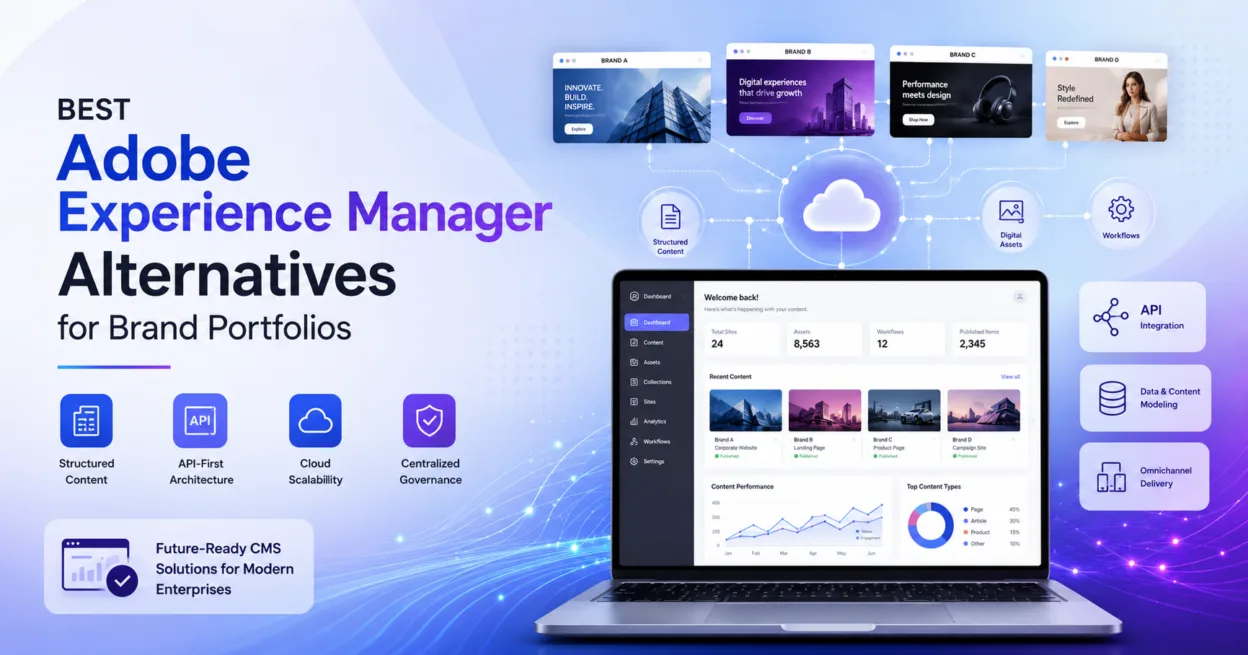
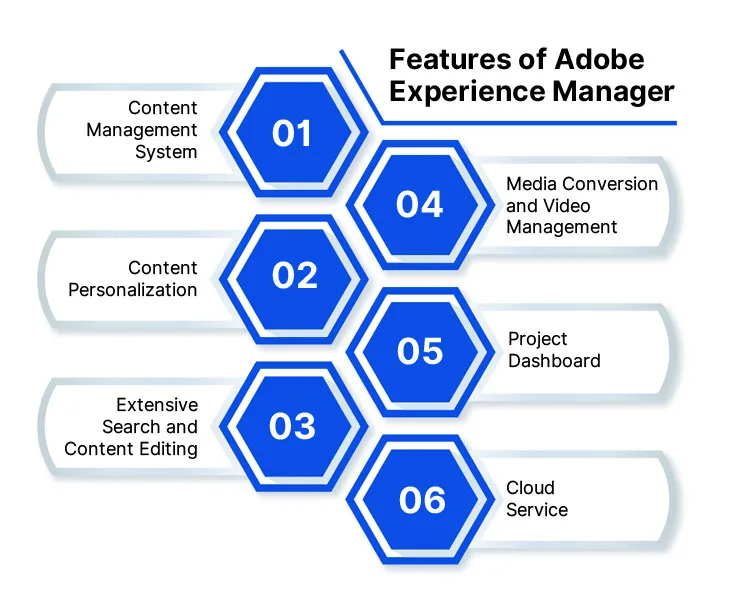
Adobe Experience Manager has long been a leading enterprise CMS, offering powerful content management, digital asset management, and personalization capabilities. However, as organizations expand through acquisitions or launch new brands, many discover that its traditional, page-centric architecture can make it more difficult to reuse content across brands, deliver consistent experiences across channels, and scale content operations efficiently.
In 2026, enterprises increasingly prioritize structured content, API-first architectures, and centralized governance that still gives individual brand teams the autonomy to manage their own content, workflows, and digital experiences. Instead of maintaining separate CMS instances or duplicating content across websites, they want a platform that enables content reuse, flexible omnichannel delivery, and shared infrastructure across an entire brand portfolio.
In this guide, we’ll explore 6 of the best Adobe Experience Manager alternatives for brand portfolios, comparing how each platform supports multi-brand management, content reuse, scalability, and omnichannel delivery to help you choose the solution that best fits your organization’s architecture and long-term growth strategy.
What to Look for in an Adobe Experience Manager Alternative
For organizations managing multiple brands, the goal is to simplify content operations, reduce infrastructure complexity, and create a scalable foundation that supports future growth.
With the global CMS market expected to reach $54 billion in 2026, enterprises are increasingly investing in platforms that can support long-term digital transformation and business growth. The best alternatives combine centralized governance with the flexibility for individual brands to maintain their own identity and workflows.
Here are the key capabilities to evaluate:
Multi-Brand Management
Managing multiple brands shouldn’t require maintaining separate CMS instances for each website. Look for platforms that let you manage multiple brands from a shared infrastructure while giving each team dedicated workspaces, permissions, and publishing workflows. This approach reduces operational overhead without sacrificing brand independence.
Structured Content and Content Reuse
Traditional page-centric content often makes it difficult to reuse information across websites and digital channels. Platforms built around structured content allow teams to create content once and reuse it across brands, regions, and touchpoints, reducing duplication and improving consistency.
API-First and Omnichannel Delivery
Modern enterprises publish content far beyond corporate websites. Whether you’re delivering content to mobile apps, ecommerce storefronts, customer portals, or digital displays, an API-first architecture ensures content can be delivered wherever it’s needed without being tied to a specific frontend.
Centralized Governance with Brand Autonomy
Large organizations need consistent governance, but individual brands also need the freedom to manage their own content. The right platform should support role-based permissions, separate workflows, and isolated content models while maintaining centralized oversight across the entire portfolio.
Scalability for Growing Brand Portfolios
As organizations launch new brands or expand through acquisitions, their CMS should scale without introducing unnecessary complexity. Platforms that support incremental onboarding, shared infrastructure, and flexible content models make it easier to integrate new brands while maintaining operational efficiency.
1. Hygraph
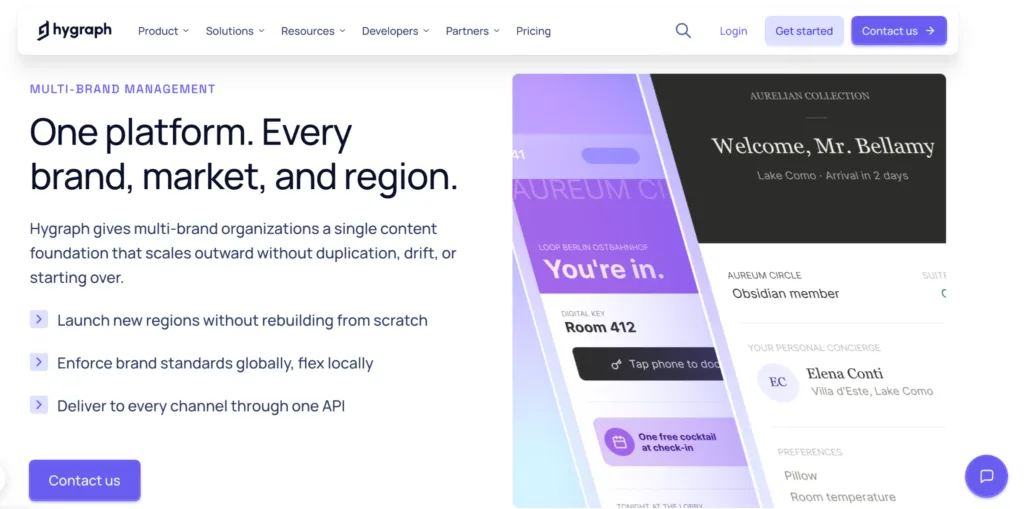
Hygraph is an API-first multi-brand content platform built for enterprises operating diverse brand portfolios from a shared content infrastructure. Unlike traditional CMSs that organize content around individual web pages, Hygraph uses structured content models that separate content from presentation, making it reusable across websites, mobile apps, ecommerce platforms, and other digital channels.
Each brand operates within its own isolated content space with independent schemas, workflows, and permissions while sharing the same underlying platform. This architecture gives central platform teams unified governance without limiting the autonomy of individual brand teams. As organizations expand through acquisitions or launch new brands, they can scale their content operations without continually adding new CMS instances.
Why it’s a great Adobe Experience Manager alternative
Hygraph takes an architecture-first approach that differs from traditional monolithic platforms like Adobe Experience Manager. Monolithic CMSs were designed for page-centric web delivery, where content is closely coupled to the presentation layer, making it harder to reuse across brands, channels, and frontend applications.
Hygraph separates content from presentation by treating it as structured, reusable data that can be delivered to any channel through APIs. For organizations planning to move from AEM to a headless CMS, this provides a more flexible foundation for managing growing brand portfolios, sharing content across brands, maintaining independent workflows, and onboarding newly acquired brands without adding CMS instances or undertaking complex migration projects.
2. Sitecore XM Cloud
Sitecore XM Cloud is a cloud-native digital experience platform designed for enterprises managing multiple websites and brands. It combines headless content management with cloud hosting, allowing organizations to deliver content across websites and digital channels while reducing the operational burden of on-premises infrastructure.
The platform supports reusable content, multi-site management, and enterprise-grade governance to help maintain consistency across large digital ecosystems. It also integrates with the broader Sitecore ecosystem for personalization, analytics, and digital marketing capabilities. This makes Sitecore XM Cloud a strong option for organizations modernizing legacy content operations without moving away from the Sitecore platform.
Why it’s a great Adobe Experience Manager alternative
Like Adobe Experience Manager, Sitecore XM Cloud is built for enterprise-scale digital experiences, but its cloud-native architecture simplifies deployment, upgrades, and ongoing platform maintenance. Organizations managing multiple brands can centralize governance while supporting independent websites and localized content from a shared platform.
Its headless capabilities also make it easier to deliver content across multiple channels without being limited to traditional web experiences. For enterprises already invested in personalization and customer experience, Sitecore XM Cloud provides a modernized architecture while retaining many of the enterprise capabilities expected from a digital experience platform.
3. Optimizely CMS
Optimizely CMS is an enterprise content management system that combines content management with experimentation and digital optimization. Organizations can manage multiple websites from a single platform while supporting personalized experiences across digital channels.
The platform offers structured content management, flexible publishing workflows, and integrations with Optimizely’s experimentation and commerce products. Its cloud-based architecture supports enterprise scalability while giving marketing and development teams collaborative workflows. This combination makes it well-suited for organizations focused on continuously improving digital experiences across multiple brands.
Why it’s a great Adobe Experience Manager alternative
Optimizely CMS offers many of the enterprise capabilities expected from Adobe Experience Manager while placing a stronger emphasis on experimentation and continuous optimization. Organizations can manage multiple brand websites from a centralized platform while tailoring experiences for different audiences and markets.
Compared with more traditional CMS deployments, its cloud-native architecture streamlines updates and reduces operational complexity. Businesses looking to combine enterprise content management with testing, personalization, and optimization may find Optimizely CMS a more integrated approach to managing growing brand portfolios.
4. Liferay
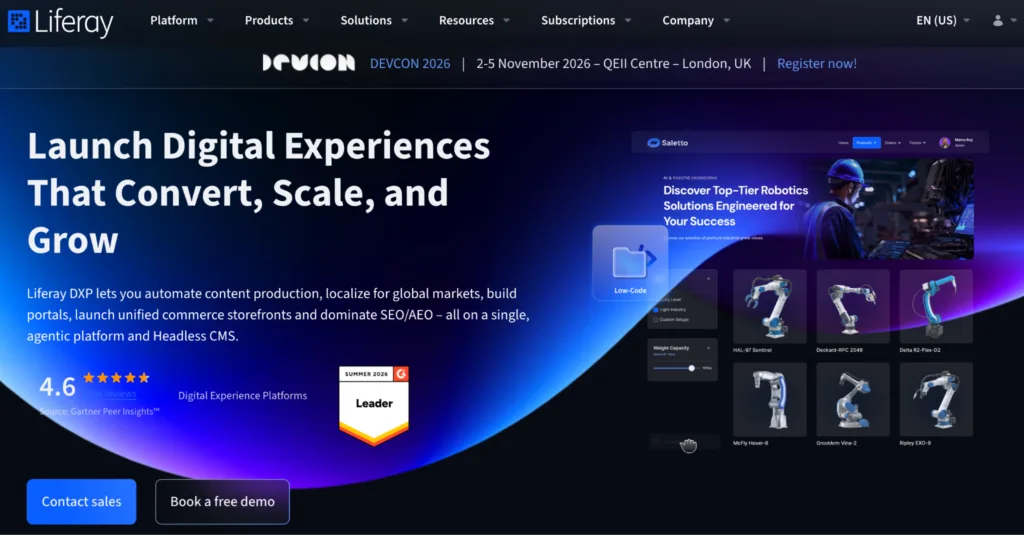
Liferay is an enterprise digital experience platform that helps organizations build customer portals, partner portals, employee portals, and branded digital experiences from a unified platform. It combines content management with workflow automation, identity management, and extensive integration capabilities.
Organizations can manage multiple sites and digital properties while maintaining centralized governance and security. Its open architecture allows developers to connect existing enterprise systems and extend functionality as business needs evolve. This flexibility makes Liferay particularly suitable for organizations with complex digital ecosystems beyond traditional marketing websites.
Why it’s a great Adobe Experience Manager alternative
Liferay provides a broader enterprise platform for organizations that need more than website content management. Its strengths lie in connecting multiple digital experiences, business applications, and user portals through a single architecture. Organizations managing multiple brands can centralize governance while supporting different customer, employee, or partner experiences across business units. For enterprises that prioritize integration, workflow automation, and digital experience management alongside content management, Liferay offers a flexible alternative to Adobe Experience Manager.
5. Kentico Xperience
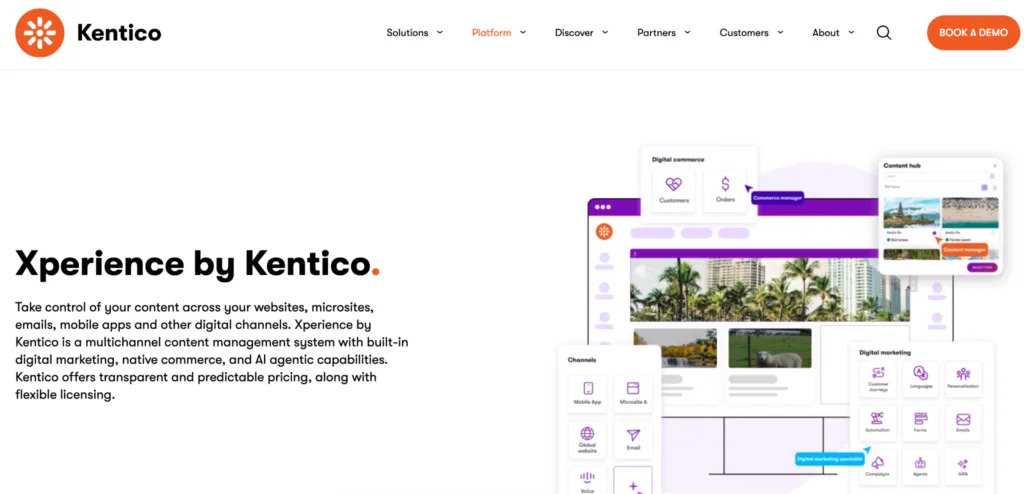
Kentico Xperience is a digital experience platform that combines enterprise content management, digital marketing, and ecommerce capabilities within a single solution. It enables organizations to manage multiple websites and digital experiences while maintaining consistent branding and content governance.
The platform includes reusable content components, personalization tools, marketing automation, and flexible integrations with third-party systems. Its hybrid headless capabilities allow teams to deliver content across multiple channels while supporting both traditional and modern development approaches. This balance makes Kentico Xperience a practical choice for organizations seeking enterprise functionality without the complexity of larger DXP ecosystems.
Why it’s a great Adobe Experience Manager alternative
Kentico Xperience delivers many of the capabilities organizations expect from Adobe Experience Manager in a platform that’s often simpler to implement and manage. Multi-site management, reusable content, and centralized governance help organizations maintain consistency across growing brand portfolios.
Its hybrid headless architecture also provides greater flexibility for delivering content to websites and other digital channels while allowing teams to modernize at their own pace. Organizations looking for enterprise content management without the operational overhead commonly associated with larger monolithic platforms may find Kentico Xperience a compelling alternative.
6. Alfresco
Alfresco is an enterprise content services platform focused on document management, records management, and content governance. Organizations use it to centralize business content while maintaining compliance, security, and collaboration across departments and regions.
The platform provides open APIs, workflow automation, and integration with existing enterprise applications, making it suitable for complex content ecosystems. Its open architecture supports custom business processes while ensuring enterprise-grade governance and auditability. Alfresco is particularly valuable for organizations where structured business content and regulated documentation are core operational requirements.
Why it’s a great Adobe Experience Manager alternative
Although Alfresco is not a traditional web CMS, it offers a strong alternative for organizations whose primary challenge is enterprise content governance rather than website management alone. Its open architecture, workflow automation, and document lifecycle management make it well suited for organizations managing large volumes of regulated content across multiple business units or brands.
Compared with Adobe Experience Manager’s emphasis on digital experiences, Alfresco focuses on enterprise-wide content control, compliance, and integration with business systems. For organizations that prioritize governance, records management, and structured enterprise content over marketing-driven web experiences, Alfresco can be a better architectural fit.
Which Adobe Experience Manager Alternative Is Right for Your Brand Portfolio?
Brand portfolios place different demands on a CMS than single-brand organizations. While every platform on this list supports enterprise content management, each excels in a different area (from API-first architecture and multi-brand scalability to digital experience management and enterprise governance). Use the table below as a quick reference to identify the platform that best aligns with your priorities.
| If your priority is… | Best Choice |
| Consolidating multiple brands on a modern API-first architecture | Hygraph |
| Replacing AEM with another enterprise DXP | Sitecore XM Cloud |
| Combining content management with experimentation | Optimizely CMS |
| Managing enterprise portals alongside branded experiences | Liferay |
| Running marketing-focused websites across multiple brands | Kentico Xperience |
| Centralizing enterprise documents and governed content | Alfresco |
Conclusion
Adobe Experience Manager remains a capable enterprise CMS, but it’s no longer the only option for organizations managing complex brand portfolios. As enterprises expand across multiple brands, regions, and digital channels, many are looking for platforms that simplify content operations, improve content reuse, and support modern, API-first architectures.
The right alternative ultimately depends on your organization’s priorities. If you want to modernize a traditional enterprise DXP while retaining familiar capabilities, platforms like Sitecore XM Cloud or Optimizely CMS may be a good fit. Organizations focused on enterprise portals, marketing-driven digital experiences, or content governance may find Liferay, Kentico Xperience, or Alfresco better aligned with their needs.
For enterprises looking to move beyond traditional monolithic, page-centric CMS architecture, Hygraph offers a different approach. By separating content from presentation and enabling multiple brands to operate from a shared, API-first platform, it provides a scalable foundation for content reuse, omnichannel delivery, and long-term portfolio growth. As brand ecosystems continue to expand through new launches and acquisitions, this architectural approach can help organizations reduce operational complexity while giving individual brands the flexibility to evolve independently.
Ultimately, the best Adobe Experience Manager alternative is the one that supports both your current digital ecosystem and your organization’s future growth.