Your first support hire is the one you keep postponing. But one day a product launch brings a flood of calls, while a busy weekend leaves your inbox full of unanswered tickets.
Most small ecommerce businesses start considering call center outsourcing when customer calls and support tickets become too much to handle alone. But they need a very different type of provider from a large retailer. The right partner should be able to handle a few hundred calls a month, work with platforms like Gorgias or Zendesk, and offer a flexible contract that you can end with 30 days’ notice.
For this list, we looked for three things: low minimum volumes, clear per-call or per-agent pricing, and easy integration with help desk platforms. Based on these criteria, eight providers stand out in 2026: Helpware, Influx, SupportYourApp, Peak Outsourcing, SupportNinja, Simply Contact, Smith.ai, and Wing Assistant.
What Outsourcing Actually Replaces
Hiring one customer service representative in the U.S. can cost more than many small businesses expect. The median annual pay is $42,830, or $20.59 an hour, according to the U.S. Bureau of Labor Statistics. Once you add payroll taxes, benefits, help desk software, and holiday coverage, the total cost can easily exceed $50,000 a year. And that gives you one person, working one shift, usually in one language.
With outsourcing, the same budget can provide broader coverage, including evenings, weekends, peak sales periods, and multilingual support. Outsourcing providers have also adapted quickly to automation. Many now use chatbots for simple questions, such as order status and tracking, while human agents handle more complex issues like refunds, disputes, and difficult customer conversations.
The U.S. Bureau of Labor Statistics expects customer service employment to decline by 5% between 2024 and 2034, largely because of self-service and automation. For small businesses, outsourcing can provide access to these technologies without having to build the entire support operation themselves.
Finding a provider willing to take on a small account is the harder problem. The same customer experience decisions that shape your storefront show up on the phone line, and a store that gets checkout right can still lose the customer on hold.
How to Choose a Partner When You Do 200 Orders a Month
If you have a small call volume, focus on five things when comparing providers: the minimum commitment, the billing model, help desk and platform integration, coverage hours matched to your real call pattern, and agent turnover. Certifications join that list the moment you take card details by phone or ship into the EU.
- Minimum commitment. Ask for the smallest team the provider will staff and the shortest term it will sign. Plenty of BPOs quote a 10-agent minimum on a 12-month term, which prices out a store handling 300 tickets a month.
- Billing model. Per call suits low and predictable volume. Per agent suits a steady queue. Per resolution suits stores whose volume swings hard between peak and quiet months.
- Integration. Agents should work inside your help desk and your store admin. If you run Magento, ask whether the team has processed orders, refunds, and RMAs in the admin itself, not only in Zendesk.
- Coverage. Pull last quarter’s call log before you buy 24/7. Most small stores find the real gap sits between 6 p.m. and midnight local time.
- Compliance. PCI DSS Level 1 certification matters when agents read card numbers over the phone. GDPR alignment matters the day you ship to Berlin.
- Turnover. Ask for monthly attrition and average agent tenure on accounts your size. Low turnover shows up in resolution times within a quarter.
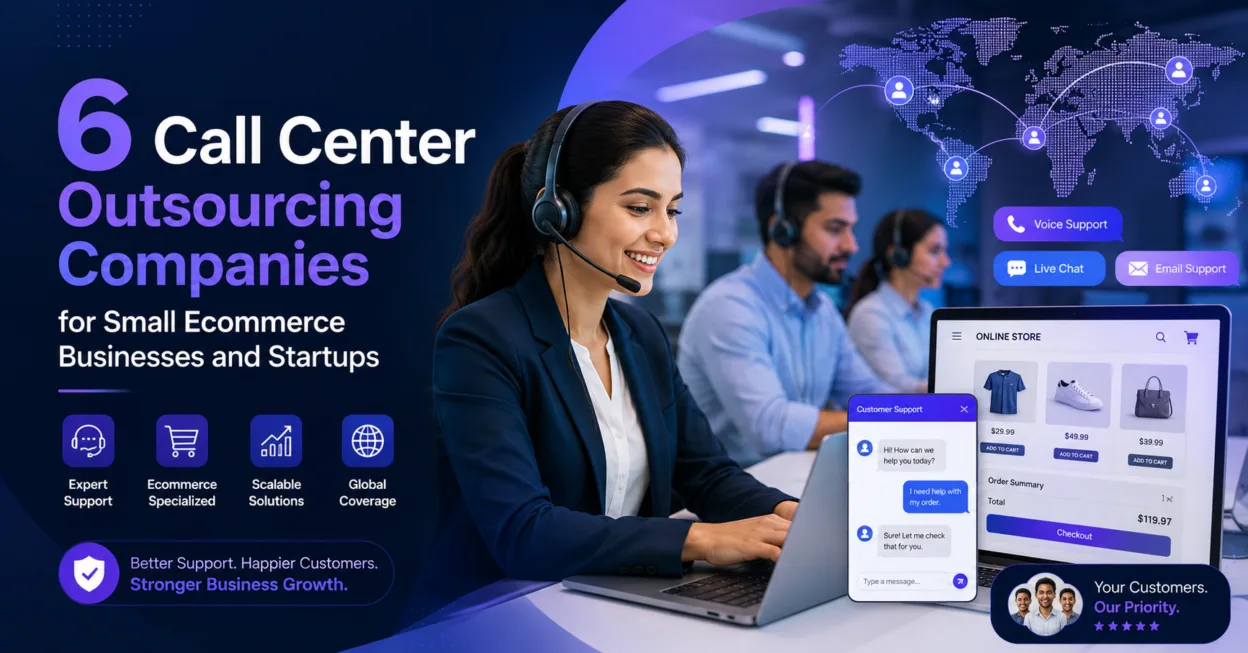
6 Call Center Outsourcing Companies for Small Ecommerce Businesses and Startups
1. Helpware
Best for: stores that want one partner for voice, order processing, and back office as they grow.
The company runs CX operations from 19 locations across four continents in 45+ languages, with an ecommerce team covering order processing, returns, help desk, and both inbound and outbound calling.
Nothing degrades support quality at small scale faster than agents leaving. A rep who has learned your SKUs, your returns policy, and your three most common shipping complaints outperforms a rep who started on Monday, and a 200-order-a-month store cannot absorb constant retraining. Helpware reports a 2.8 percent monthly attrition rate alongside 90 percent CSAT across its CX operations, which is the kind of figure worth requesting from every provider on this list before you sign.
Worth checking: Since the company focuses on large enterprise clients, make sure it can support a small team at your volume and ask about its minimum staffing requirement.
2. Influx
Best for: seasonal spikes and founders who refuse to sign an annual contract.
Founded in 2013, Influx built its model around month-to-month billing and burst coverage, with a follow-the-sun team answering around the clock. Agents and managers go through two to four weeks of training on a new client’s product before they take live contacts. When your volume triples in November and collapses in January, the ability to scale a team up and down without reopening a contract beats a lower hourly rate.
Worth checking: pricing arrives by quote, so map your peak month and your quiet month before the first call.
3. SupportYourApp
Best for: stores handling card data, EU customers, or technical products.
Operating since 2010 and founded in Kyiv, this provider covers 60+ operational languages and holds PCI DSS Level 1 and ISO 27001:2022 certification, with GDPR, CCPA, and HIPAA alignment. It reports work with 250+ clients across 30+ countries. If your checkout touches payment data or your customer records fall under GDPR, those certifications move from nice-to-have to a procurement requirement.
Worth checking: the center of gravity sits in SaaS and fintech, so ask for ecommerce references and sample workflows for returns and chargebacks.
4. Peak Outsourcing
Best for: DTC brands that want agents working inside their existing stack.
Founded in 2011 with delivery centers in the Philippines and Belize, Peak Outsourcing lists Shopify, Magento, BigCommerce, Zendesk, Gorgias, Stripe, and PayPal among the systems its teams operate in, and it assigns dedicated agents rather than shared pools. Most programs launch in 30 to 45 days, with some support functions live in two to three weeks.
Worth checking: With dedicated agents, you pay for a fixed number of agents each month, even when call volume changes. This model makes more sense when you have enough work to keep at least one full-time agent busy.
5. SupportNinja
Best for: startups scaling past the stage where the founder answers everything.
Cody McLain founded SupportNinja to give startups BPO-grade support without contract structures designed for large enterprises. The company runs delivery from Clark and Metro Manila with US headquarters in Texas, and covers phone, chat, email, lead generation, content moderation, and back-office work. It has ranked on the Inc. 5000 list for several consecutive years, placing No. 2653 in 2025.
Worth checking: The company mainly works with tech and SaaS businesses, so ask for examples of retail clients, especially those that needed extra support during busy seasons.
6. Simply Contact
Best for: European customers and multilingual queues.
Founded in 2013 and headquartered in Warsaw, Simply Contact runs 700+ agents across eight European locations and handles more than 10 million customer requests a year in 20+ languages. Its client list includes Wizz Air, Bolt, and Yves Rocher. European delivery costs more than an offshore team in Asia and less than a US team, which suits stores selling into Germany, France, and Poland where customers expect to reach someone in their own language.
Worth checking: The company has more experience in travel, aviation, and fintech than in retail, so check how much relevant ecommerce and retail experience the team actually has.
Side-by-Side Comparison
Use this to narrow eight names down to two or three before you book any calls.
| Provider | Best for | Delivery model | Commitment signal |
| Helpware | One partner for voice, order processing, and back office as you scale | Onshore, nearshore, and offshore across 19 locations | Custom quote; confirm smallest staffed team |
| Influx | Seasonal spikes and burst coverage | Follow the sun, global remote teams | Month to month, no lock-in |
| SupportYourApp | Card data, EU customers, technical products | Global hubs, 60+ operational languages | Custom quote; onboarding in weeks |
| Peak Outsourcing | DTC brands wanting agents inside their stack | Philippines and Belize, dedicated agents | Launch in 30 to 45 days |
| SupportNinja | Startups scaling past founder-led support | Philippines delivery, US headquarters | Custom quote; startup-oriented terms |
| Simply Contact | European and multilingual queues | 700+ agents across eight European sites | Custom quote; project-based scoping |
Five Questions to Ask on the First Call
The first call with a potential outsourcing partner is your chance to see how well they understand your business and whether their service actually fits your needs. Don’t use it just to discuss pricing. Use the call to test their flexibility, experience, technology, and ability to handle your busiest periods.
- What is the smallest team you can provide, and what is the shortest contract you offer?
- What was your average monthly agent turnover last year for clients similar to us?
- Can you walk me through how an agent would handle a refund using our help desk and store platform?
- Which security and compliance certifications do you have, and when was your most recent audit?
- How do you handle staffing and pricing during our busiest four weeks of the year?
A good provider should be able to answer these questions clearly and directly. If they are vague about agent turnover, minimum staffing, or peak-season coverage, treat that as a warning sign—not something to clarify after you’ve signed the contract.
Where to Start
Match the provider to your volume rather than to your ambition. Under 100 calls a month, a per-call service such as Smith.ai costs less than any dedicated team. Between 100 calls and a full-time queue, Influx and Wing Assistant let you buy capacity without committing to headcount. Once support becomes a permanent function with peak-season swings, multiple languages, or card data on the line, a managed BPO such as Helpware, SupportYourApp, Peak Outsourcing, SupportNinja, or Simply Contact will hold quality better than a patchwork of freelancers.
Run a 60-day pilot with two providers before you commit to either. Measure first-response time, resolution rate, and CSAT against your own numbers from the same period last year. The provider that wins on those three metrics is the one to scale with.
Frequently Asked Questions
How much does call center outsourcing cost for a small ecommerce business?
Pricing depends on the support model. Per-call services can start at a few hundred dollars a month for a small volume, while dedicated-agent plans typically start around $1,200 per month per agent. Managed BPO teams usually provide custom quotes based on volume, coverage, and scope.
Can a startup outsource phone support with no minimum volume?
Yes. Some providers offer flexible, month-to-month plans or per-call pricing, making outsourcing possible even for startups with very low call volumes. However, minimums vary, so always ask about the smallest volume they support and the shortest contract term.
Should you outsource support before hiring in-house?
For many small ecommerce businesses, outsourcing makes sense before hiring a full-time support employee. One in-house agent can cost $50,000+ a year once you include benefits and software, while still covering only one shift. Outsourcing can give you more flexible coverage, including evenings, weekends, peak periods, and multilingual support, without the cost of a full-time hire.
What should an outsourced call center integrate with?
At a minimum, the provider should integrate with your help desk, such as Zendesk, Gorgias, or Freshdesk, and yo