
An AI agent is different from most software a company deploys. It doesn’t just display information or follow a fixed workflow. It interprets instructions, decides what to do, and takes action reading records, updating systems, sending messages, triggering processes.
That makes agents useful. It also makes them a new kind of risk surface. An agent with broad permissions and weak controls can expose sensitive data, take unauthorized actions, or be manipulated by carefully crafted inputs.
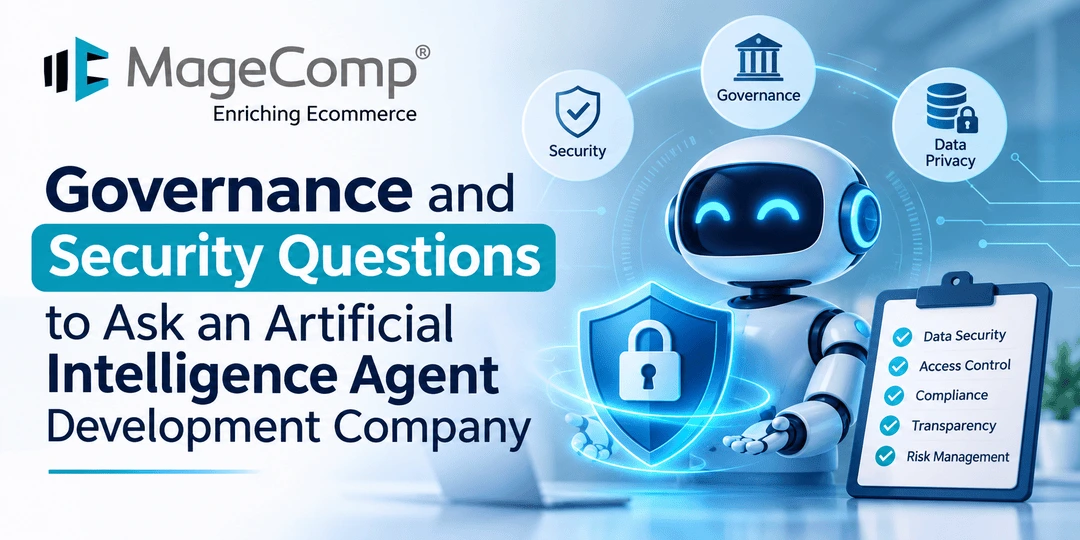
For security, compliance, and risk teams, the vendor that builds the agent matters as much as the agent itself. Below are the governance and security questions worth asking any artificial intelligence agent development company before work begins and what good answers look like.
The Core Risk Areas
| Risk Area | What Can Go Wrong | Control to Expect |
| Excessive permissions | Agent accesses or changes data it shouldn’t | Least-privilege access scoped per task |
| Prompt injection | Malicious input manipulates the agent’s behavior | Input filtering, instruction isolation, output validation |
| Data leakage | Sensitive data sent to external models or exposed in outputs | Data classification, masking, approved model endpoints |
| Unreviewed actions | Agent takes high-impact actions without oversight | Approval workflows and action thresholds |
| Lack of traceability | Nobody can explain why an agent did something | Complete audit logs of inputs, reasoning steps, and actions |
| Model changes | Provider updates change agent behavior | Version pinning, regression testing before upgrades |
| Uncontrolled costs | Loops or misuse drive unexpected spend | Usage limits, rate limiting, and alerts |
Access and Permissions
What systems will the agent access, and with what permissions?
A good answer lists specific systems and specific operations read only access to the order database, write access to the ticketing system limited to status fields. A weak answer is “the agent will need admin access to integrate properly.
How are credentials managed?
Expect secrets stored in a dedicated vault, not in code or configuration files. Expect separate credentials per environment and per agent, with rotation policies.
Does the agent act with its own identity or the user’s?
Both approaches can be valid, but the choice should be deliberate. When an agent acts on behalf of a user, it should be limited to what that user is allowed to do.
Input and Output Safety
How do you protect against prompt injection?
Prompt injection where content the agent reads contains instructions that hijack its behavior is one of the most significant agent specific risks. Credible vendors describe layered defenses: separating trusted instructions from untrusted content, limiting what actions can be triggered by external content, validating outputs before actions are executed, and testing specifically for injection attempts.
How are outputs validated before actions are taken?
Look for structured outputs checked against business rules, with high impact actions requiring explicit confirmation.
Data Protection
Where is data processed and stored?
Know which model providers are used, where they process data, and whether data is retained or used for training. For regulated industries, data residency may determine which models and hosting options are acceptable.
How is sensitive data handled?
Expect classification of data the agent may encounter, masking or redaction of sensitive fields where possible, and controls preventing sensitive data from appearing in logs or outputs inappropriately.
How does the design align with applicable regulations?
Depending on your industry and geography, relevant frameworks may include data protection laws, sector specific requirements, and emerging AI specific regulations. The vendor should understand which apply and how the design addresses them.
Oversight and Control
Which actions require human approval?
A clear answer defines thresholds: monetary limits, data sensitivity levels, or action types that trigger review.
Can the agent be paused or shut down quickly?
There should be a straightforward way to disable an agent or specific capabilities immediately, without a code deployment.
How are errors and low confidence situations handled?
Expect defined fallback behavior: escalation to a human, safe default actions, and clear communication to users.
Traceability and Auditing
What is logged?
Comprehensive logs should capture inputs, retrieved context, tool calls, decisions, and outputs enough to reconstruct why an agent took a specific action.
How long are logs retained, and who can access them?
Retention should align with your compliance requirements, and access should be restricted.
Can you explain a specific decision after the fact?
Ask the vendor to walk through how they’d investigate an incident in a past project.
Testing and Change Management
How is the agent tested for security issues?
Look for adversarial testing deliberate attempts to make the agent misbehave as well as standard security testing of integrations and infrastructure.
What happens when the model provider updates a model?
Expect pinned model versions in production and a regression test suite run before any upgrade.
How are changes to agent behavior reviewed and approved?
Changes to prompts, tools, or permissions should follow a review process, just like code changes.
Vendor Practices
What security certifications and practices does your organization maintain?
Certifications such as ISO 27001 indicate an established information security management system. They don’t guarantee agent specific security, but they show organizational maturity.
How do your engineers access our systems and data during development?
Expect controlled access, use of test or anonymized data where possible, and clear offboarding when the engagement ends.
Building Governance Into the Engagement
Security and governance are much cheaper to design in than to retrofit. Practical steps:
- Involve your security and compliance teams during discovery, not just before launch.
- Include a threat model for the agent as a project deliverable.
- Define approval thresholds and escalation rules in the agent specification.
- Require audit logging and monitoring as part of the definition of done.
- Schedule periodic security reviews after launch.
AI agents can deliver substantial value, but only when they’re trusted by users, by security teams, and by regulators. Choosing an artificial intelligence agent development company that takes governance and security as seriously as functionality is what makes that trust possible. Ask the hard questions early; the right vendor will have clear, specific answers.