

In the race to modernize IT infrastructure across U.S. enterprises, migrating to the cloud is no longer optional-it’s a strategic necessity driven by scalability, compliance, and cost efficiency. However, executing the right approach is what separates successful transformations from costly failures. Yet despite the maturity of platforms like Microsoft Azure, most migrations still fail to deliver expected outcomes. Budgets overrun, timelines slip, and systems break in subtle but costly ways.
Why? Because cloud migration is often treated as a technical task, not a business transformation.
To move beyond theory, this guide outlines real-world migration to Azure cloud steps, based on insights from Ernest Karapetau, CEO & Founder at Softellar, who has led dozens of technology and digital transformation projects across finance, healthcare, and enterprise SaaS. His experience highlights what actually works in real-world cloud migrations. What follows is not another high-level overview, but a field-tested framework—combining Microsoft’s Cloud Adoption Framework (CAF) with real execution patterns and lessons learned from production environments.
Before diving into migration strategies, many organizations rely on custom .NET solutions to modernize legacy systems and prepare them for cloud environments.

1. Migration Starts Before Technology
At this stage, defining the correct approach is more important than selecting tools.
One of the most consistent failure points in cloud migration is premature execution.
“If you start migrating workloads before understanding your dependencies, you’re not migrating-you’re gambling.”
According to Bahdanovich, the real starting point is not Azure-it’s visibility.
In practice, especially in large U.S. enterprise environments, this means building a complete digital estate inventory:
- Servers, databases, applications
- Network topology
- Hidden and indirect dependencies
Using Azure Migrate, teams can scan environments (VMware, Hyper-V, physical, even multi-cloud) and uncover relationships that are rarely documented.
In one financial services project, Softellar discovered that multiple reporting systems depended on a legacy database that wasn’t even listed as critical. Migrating those systems independently would have caused silent data corruption. Instead, the team consolidated data pipelines and migrated them as a single logical unit into Azure SQL.
The takeaway is simple: you don’t migrate infrastructure-you migrate systems of dependencies.
2. Azure Migrate Is Not a Tool-It’s the Control Plane
Many teams treat Azure Migrate as a one-time assessment utility. In reality, it should act as the command center of the entire migration lifecycle.
It provides:
- Discovery and dependency mapping
- Readiness assessment (ready / conditional / not ready)
- Cost estimation with right-sizing
- Migration orchestration
But its real value emerges when combined with other services:
- Azure Site Recovery → near-zero downtime replication
- Database Migration Service → structured data migration
- Azure Data Box → offline transfer for large datasets
In enterprise environments, this integration replaces weeks of manual analysis.
“We’ve seen teams spend weeks building spreadsheets that Azure Migrate generates in hours-with better accuracy.”
3. The Strategy Myth: There Is No Single Right Approach
Choosing the right migration path determines both speed and long-term ROI.
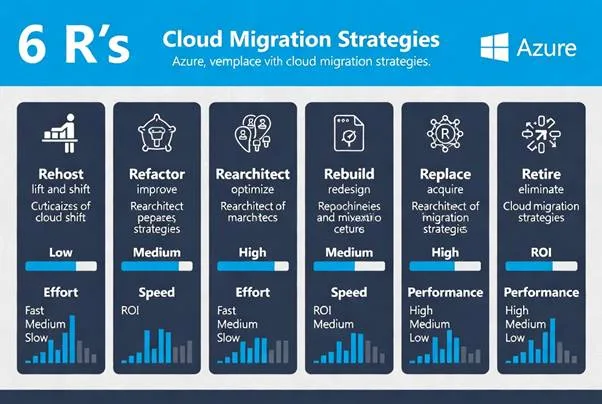
The industry often presents the 5R (or 6R) model as a checklist. In practice, it’s a portfolio strategy.
- Rehost (lift-and-shift) → speed and minimal risk
- Refactor → incremental optimization (PaaS, containers)
- Rearchitect → scalability and resilience
- Rebuild → full cloud-native rewrite
- Replace → SaaS adoption
- Retire → eliminate unused systems
The mistake is trying to apply one strategy across all workloads.
In real projects, Softellar typically follows a phased approach:
- 60–70% of workloads → Rehost or Refactor (fast wins)
- 20–30% → gradual modernization
- Remaining → rearchitect or replace selectively
In a healthcare deployment, this approach allowed 80% of infrastructure to be migrated within the first wave, while critical systems were redesigned later without disrupting operations.
The result: faster ROI without sacrificing long-term architecture quality.
4. Execution: Where Most Migrations Actually Fail
Planning does not guarantee success-execution discipline does.
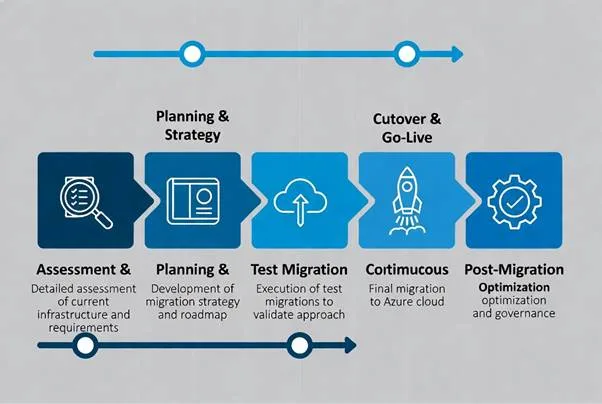
A typical migration wave includes:
1. Test Migration
- Replicate into isolated environment
- Validate performance and functionality
- Verify data integrity (checksums, row counts)
2. Cutover Strategy
Two main approaches:
- Near-zero downtime
- Continuous replication (Azure Site Recovery)
- Short write pause for final sync
- Traffic switch via DNS or load balancer
- Standard downtime
- Stop source system
- Transfer final delta
- Switch traffic
3. Rollback Plan
Always maintain the source system for 48–72 hours.
“If you don’t have a rollback plan, you don’t have a migration plan.”
In practice, most critical issues appear during testing-not production. Teams that invest heavily in pre-cutover validation avoid the majority of outages.
5. The Hidden Complexity: Dependencies, Data, and People
The biggest risks in Azure migration are rarely technical-they are systemic.
Hidden Dependencies
Applications are often interconnected in undocumented ways.
Solution:
- Use dependency visualization
- Group systems conservatively
Data Fragmentation
Different systems use inconsistent schemas and formats.
In one Softellar project, data from multiple sources had to be normalized and unified before migration into Azure SQL, preventing downstream analytics failures.
Skills Gap
Cloud-native architecture requires new competencies.
Solution:
- Upskilling internal teams
- Partnering with experienced vendors
Cost Surprises
Lift-and-shift without optimization often increases costs.
Solution:
- Right-sizing VMs
- Reserved instances
- Continuous cost monitoring
6. Migration Is Only Phase One
Even after the initial migration, most organizations are only at the beginning of their cloud journey.
A common misconception is that migration ends at cutover.
In reality, that’s where value creation begins.
Post-migration optimization includes:
- Azure Advisor recommendations
- Auto-scaling and load optimization
- Transition to serverless (Azure Functions)
- Cost governance (Azure Cost Management)
In one production system, moving backend workloads to Azure Functions on a consumption plan reduced infrastructure costs significantly by eliminating idle compute usage.
In another case, performance improvements and scalability gains enabled a client to handle higher traffic without additional infrastructure investment.
7. Governance: The Long-Term Advantage
Cloud without governance quickly becomes chaos.
Effective Azure governance includes:
- Azure Policy for compliance enforcement
- Microsoft Entra for identity and access control
- Zero-trust security model
- Regular Well-Architected Framework reviews
Organizations that treat governance as a continuous process-not a one-time setup-consistently achieve better outcomes in cost, security, and performance.
8. The Real Shift: From Infrastructure to Platform
A mature migration approach often leads organizations beyond infrastructure into platform thinking.
The most successful migrations share one characteristic: they don’t stop at infrastructure.
They evolve into platforms.
This includes:
- API-first architectures (leveraging .NET Web API + Azure services)
- Containerization (AKS)
- Event-driven systems
- DevOps automation pipelines
“Azure is not just a place to run your servers. It’s a platform to redesign how your business operates.”
Final Thought
Getting cloud migration right is not about following a checklist-it’s about building a repeatable, scalable transformation model.
Azure migration in the U.S. market is not just about moving workloads-it’s about transforming how organizations build, scale, and operate systems in a highly regulated and competitive environment..
Organizations that succeed follow three principles:
- Plan deeply before moving anything
- Execute in controlled, test-driven waves
- Optimize continuously after migration
Those that don’t, simply relocate their problems-from on-premises to the cloud.